To commemorate the two hundredth anniversary of Mary Shelley’s masterpiece, Frankenstein – originally published on 1 January 1818, the Morgan curated an art exhibition with movie memorabilia, film posters, comic books, publicity stills, aiming to explain how Frankenstein caught the popular imagination in the course of two hundred years.
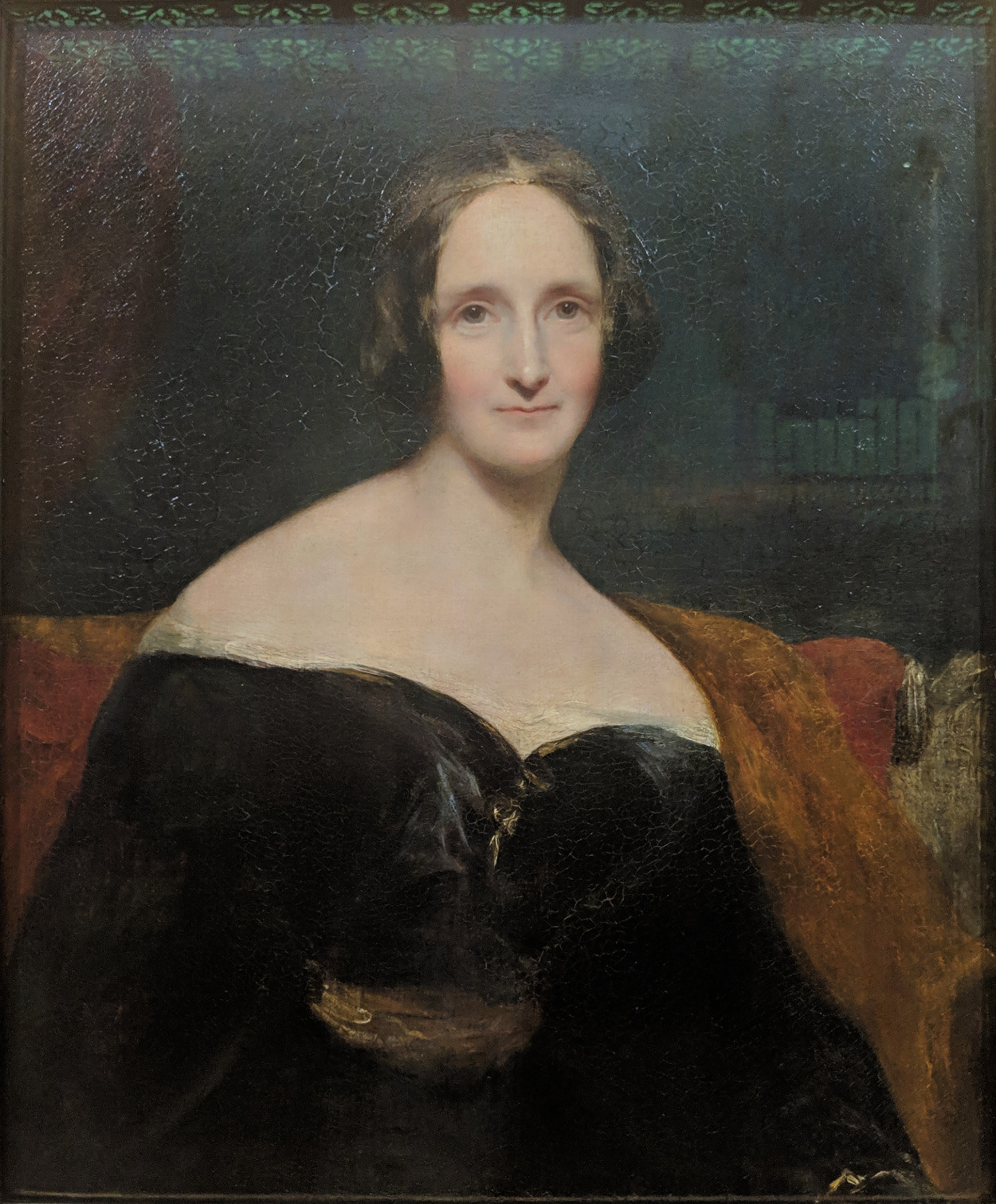 Richard Rothwell (1800-1868)
Mary Wollstonecraft Shelley, 1831
Oil on canvas
This is how the world remembers Mary Shelley: a handsome widow at the height of her fame. Percy Bysshe Shelley had drowned in 1822 when a sudden storm overturned his boat, and she returned penniless to London with their only surviving child. P.B. Shelley’s income had died with him, and his father, Sir Timothy, loathed his son and daughter-in-law and forbade her to publish under the Shelley name. Nonetheless she wrote, productively, as ”the author of Frankenstein.” Eventually she returned to society, giving modest parties where the Irish painter Richard Rothwell, the painter of this portrait, was a guest.


 The pressbook for the Bride of Frankenstein, a collection of photographs and promotional materials sent to journalists, depicts an imperious Mary Shelley whose glance projects power and knowledge. It also reflects her novel, in which the monster does demand a mate. In James Whale’s film, however, the idea of a bride originates with a new character, Dr. Septimus Pretorius, Henry Frankenstein’s former university teacher and a paragon of evil. He has come to induce Frankenstein to collaborate with him, in the scene ending with Pretorius’ toast on gin, ”my only weakness,” to ”a new world of gods and monsters!”
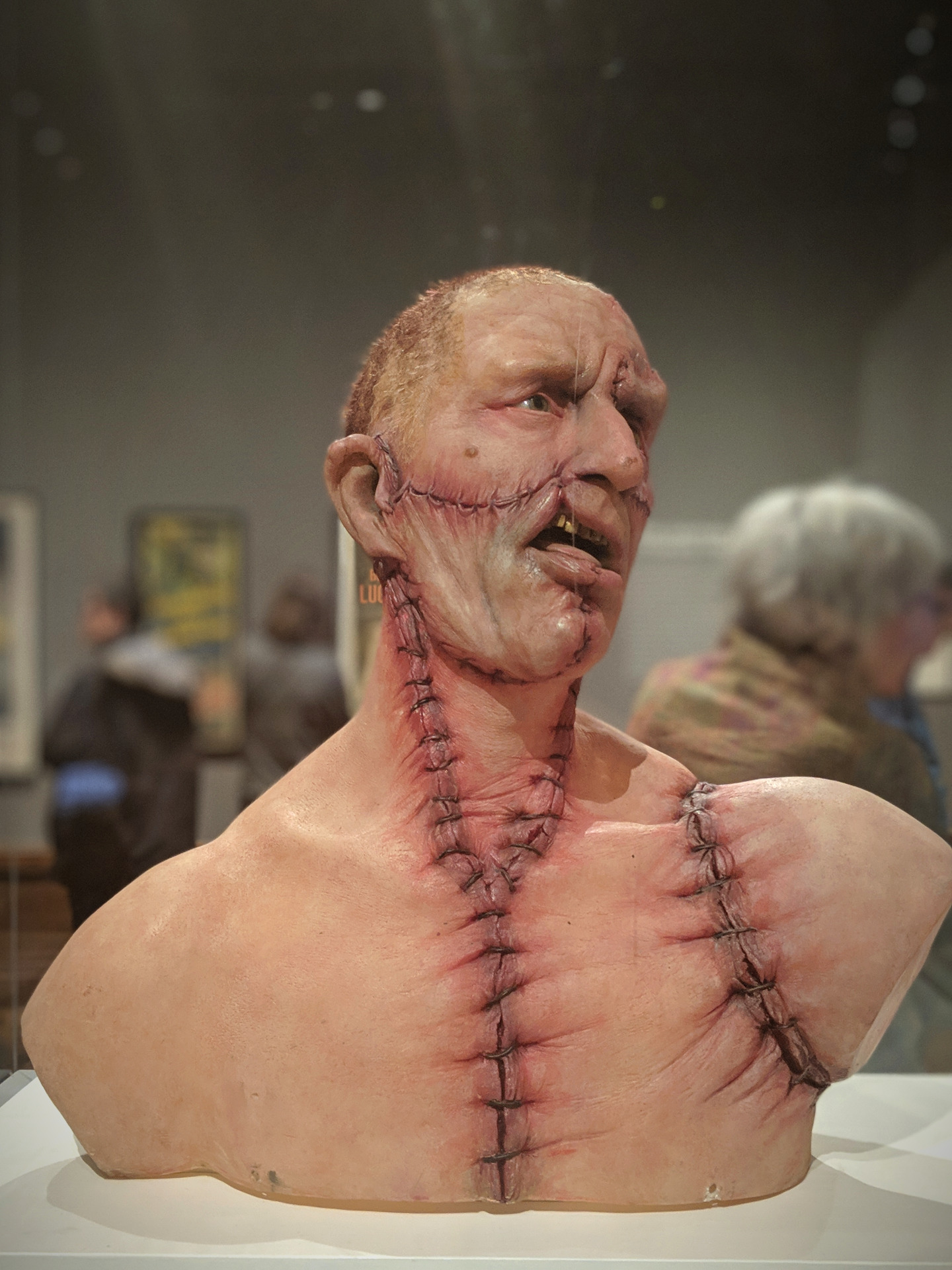 The model for Robert De Niro’s makeup is twisted in pain that might make one turn away. It was fabricated by Daniel Parker, who earned an Academy Award nomination for this makeup concept
Frankenstein (1994), directed by Kenneth Branagh
Starring Robert De Niro, Kenneth Branagh, Helena Bonham Carter
 Colour offset lithograph poster for the ”Bride of the Monster”, 1956
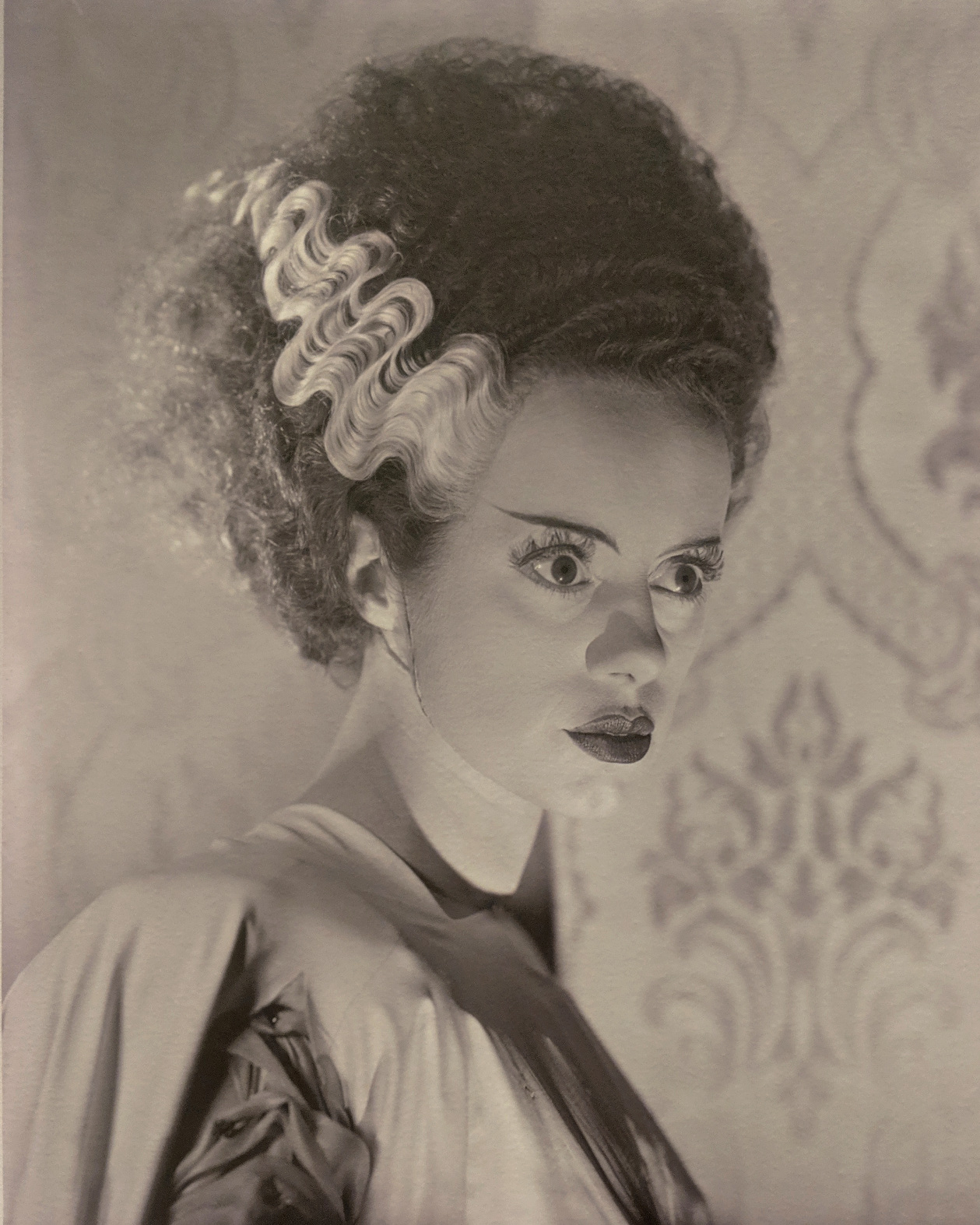 Roman Freulich (1898-1974)
Elsa Lanchester in The Bride of Frankenstein, 1935
In the novel, Victor Frankenstein destroys the bride before she is vivified. In the 1935 sequel to Frankenstein, she is given little screen time. She is brought out just long enough to be introduced, to spurn the other monster – screaming so hard at him that Lanchester’s vocal cords were damaged for months – and to be returned to death when the monster brings down the tower.
 Roman Freulich (1898-1974)
Jack Pierce devising makeup for Boris Karloff
in The Bride of Frankenstein, 1935
Boris Karloff, born William Henry Pratt, was a handsome man. Here, Pierce is at work making him ugly. The creature’s forehead is clamped where his transplanted brain has been popped in. Karloff’s head was built up with layers of collodion and cheesecloth. This was covered with blue-green greasepaint, which photographed a deathly gray. Boris Karloff removed a bridge from the side of his mouth and sucked his cheek in. Finally, because his eyes were to lively, Karloff said, ”too understanding where dumb bewilderment was so essential,” Pierce added wax to his eyelids, making them ”heavy, half-seeing”.
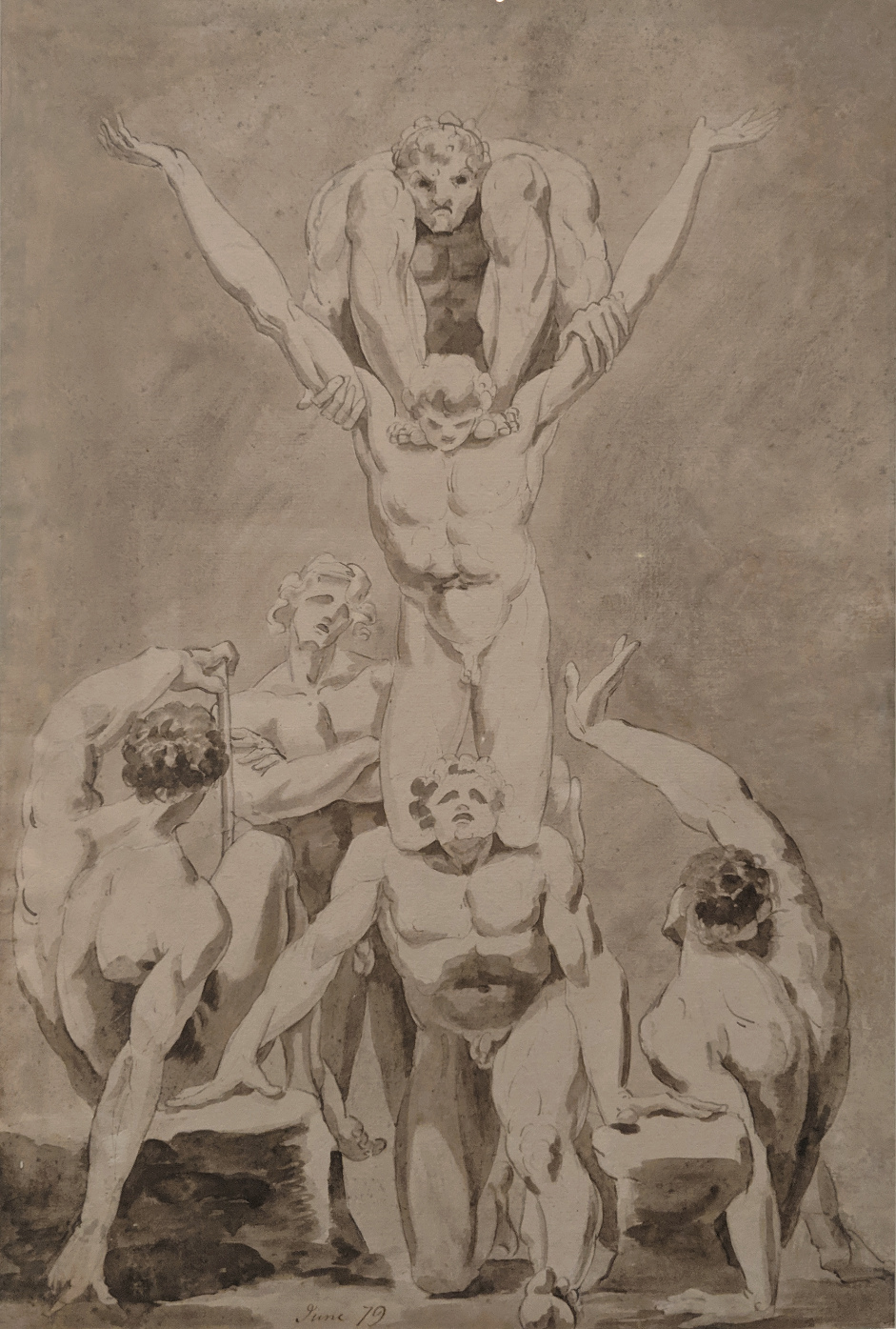 Prince Hoare (1755-1834)
Acrobats, 1779
Pen and ink, brown ink and wash over pen and black ink on laid paper
Prince Hoare may have sketched this lively group of acrobats when he was studying art in Rome with Fuseli and James Northcote. His career was unsuccessful, and he stopped exhibiting in 1785, remaking himself as a playwright. Hoare was a longtime friend of Mary Shelley’s father, William Godwin, whom Northcote painted.
 Henry Fuseli (1741-1825)
The Nigthmare, 1781
Oil on canvas
In this, the most famous of Gothic paintings, a sleeping woman is beset by a nightmare – defined by Samuel Johnson as ”a morbid oppression in the night, resembling thee pressure of weight upon the breast” – here embodied as a goblin with cat’s eyes. The mare at the window is both comical and frightening. The Swiss immigrant artist Fuseli was the first many Mary Shelley’s mother, the writer Mary Wollstonecraft, loved, and both mother and daughter would have known this painting.
 Henry Fuseli (1741-1825)
The Three Witches (or The Weird Sisters), ca. 1782
Oil on canvas
Fuseli was not above humour in his paintings. Here, the second of the three witches from Macbeth is the likeness of Fuseli’s old friend and painting master, John Jakob Bodmer. Hugely ambitious, Fuseli was celebrated not just for his visionary paintings but for his work in the lucrative market for literary scenes, and he became known as ”Shakespeare’s painter”. This is the earliest of three versions of this work, depicting the witches at the moment of their conversation with Banquo.
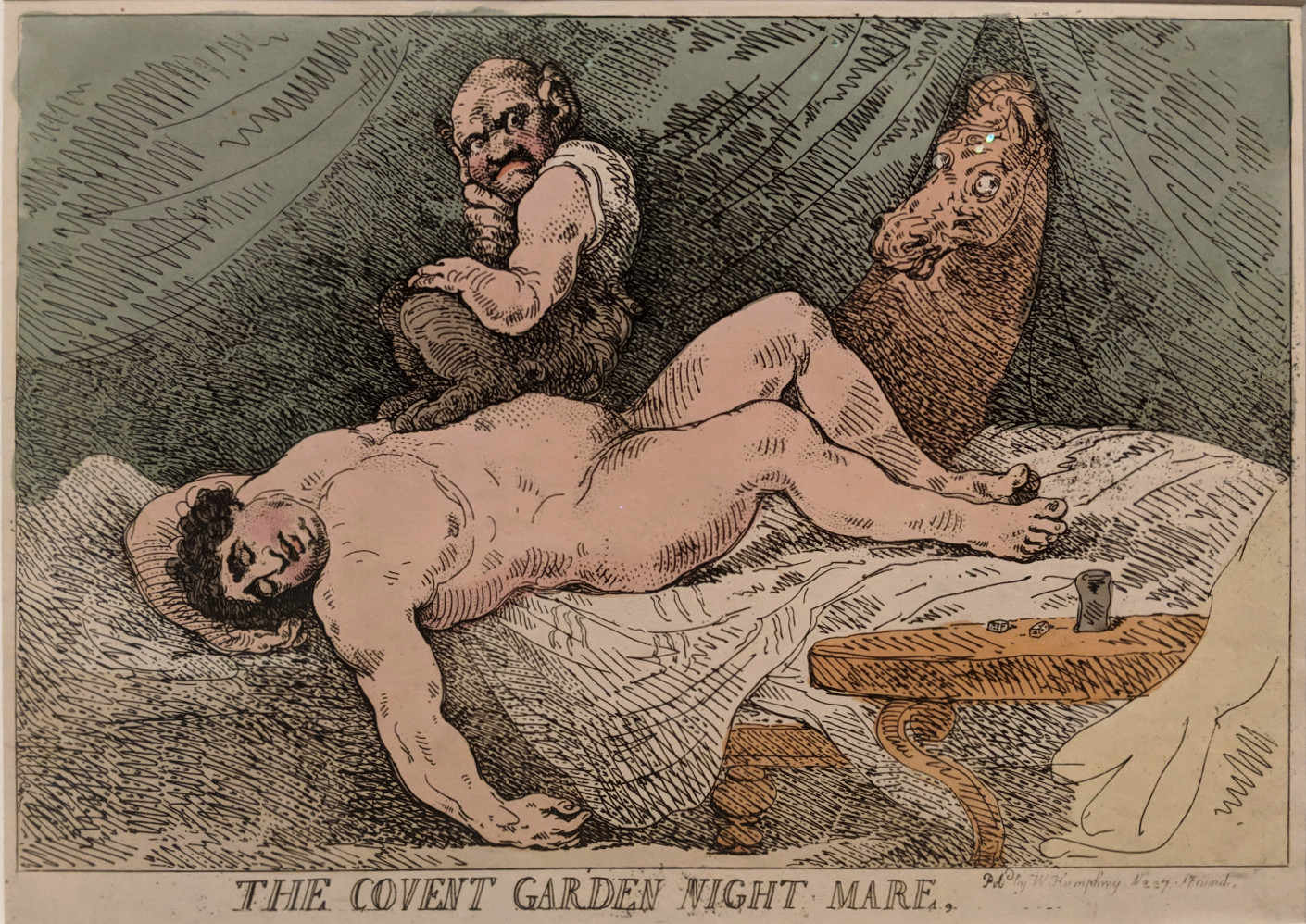 Thomas Rowlandson (1756-1827)
The Covent Garden Night Mare
Etching on wove paper, hand-coloured
The late eighteenth century was the great era of the satiric print in Britain; audiences loved the savage pleasures of their political attacks. Here, Rowlandson coopted Fuseli’s Nightmare, swapping the lissome sleeping woman for the roly-poly leader of the Whig opposition, Charles James Fox, who had just lost power in the 1784 election.
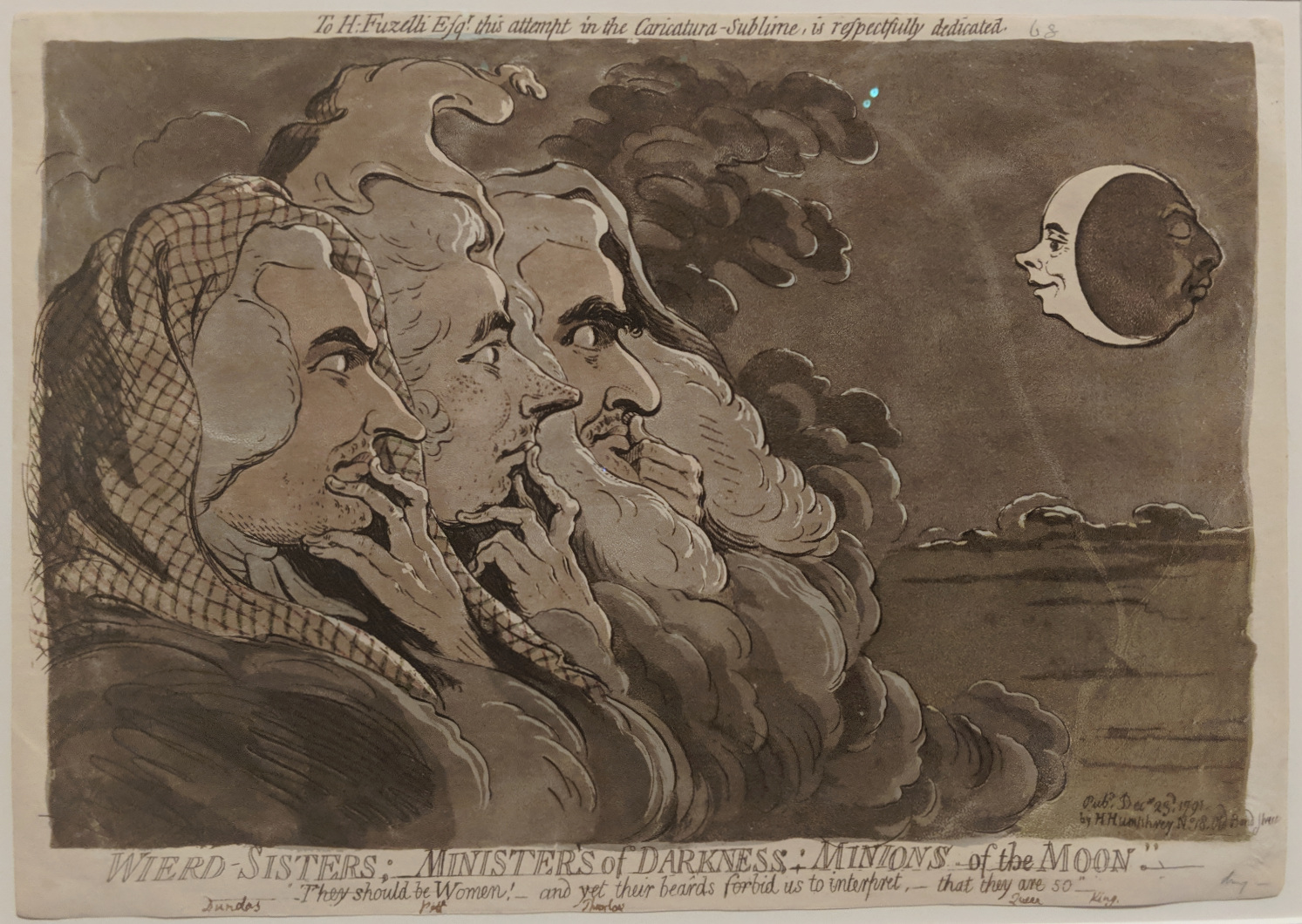 James Gillray (1756-1815)
Wierd-Sisters, Ministers of Darkness, Minions of the Moon
Etching and aquatint, hand-coloured
Gillray turned to Fuseli’s Shakespeare paintings as models six times. Wierd-Sisters, an ”attempt in the caricatura-sublime” modeled on Fuseli’s Three Witches, was seen as Gillray’s masterpiece. (Wierd is a contemporary alternative spelling).
Three witches are the three most powerful politicians at the time – William Pitt, Lord Thurlow and Lord Dundas – who were joined in an unstable government.

January 04th, 2019


















 The Humble Fabulist