Isabella Stewart Gardner Museum, part III – The Theft

We start at the Macknight Room, the only one in the Museum to be named after a contemporary artist. Dodge Macknight’s watercolours may be decorating all four walls but, today, let us focus on my favourite object adorning the room – a desk with two side cabinets (scrivania con due mobili da appoggio); second half of the 18th century.Next, a passage by Worthington Street Entrance –

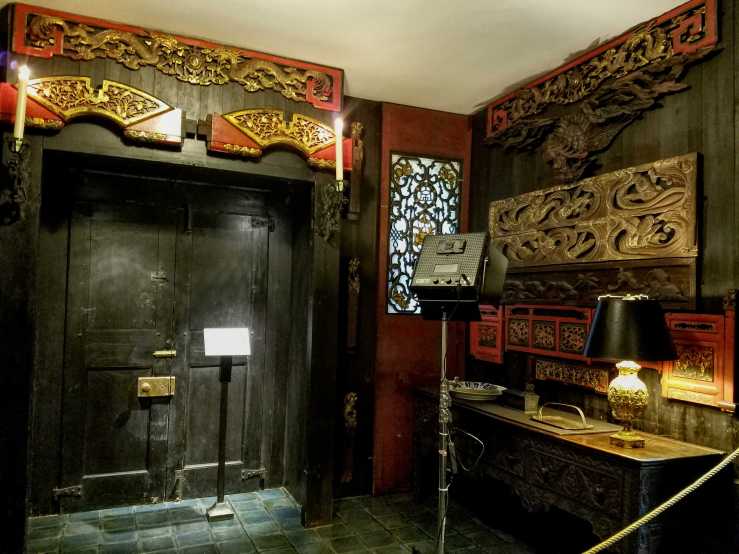
When Isabella Stewart Gardner built her museum, she made the top floor her residence and established a personal entrance to the building on Worthington Street (today Palace Road). In the spring of 2017 this space was restored to recreate her private foyer. Imagine Gardner shaking off her umbrella and enjoying artworks recently reinstalled as they were in her own time! 

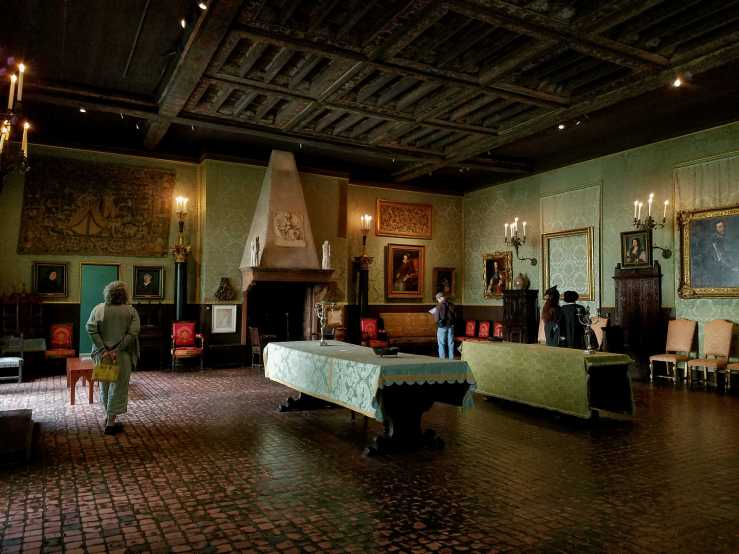
But the Museum’ eclectic collection is not only renowned for its beauty; twenty-eight years ago, it also became the focus of the world’s largest heist. In the early morning hours of March 18, 1990, a pair of thieves disguised as Boston police officers entered the Gardner Museum, tied up the guards and stole 13 works of art. The entire operation took 81 minutes and the works have never been recovered. The Museum, however, remains optimistic and offers $10 million for any information leading to the stolen art.

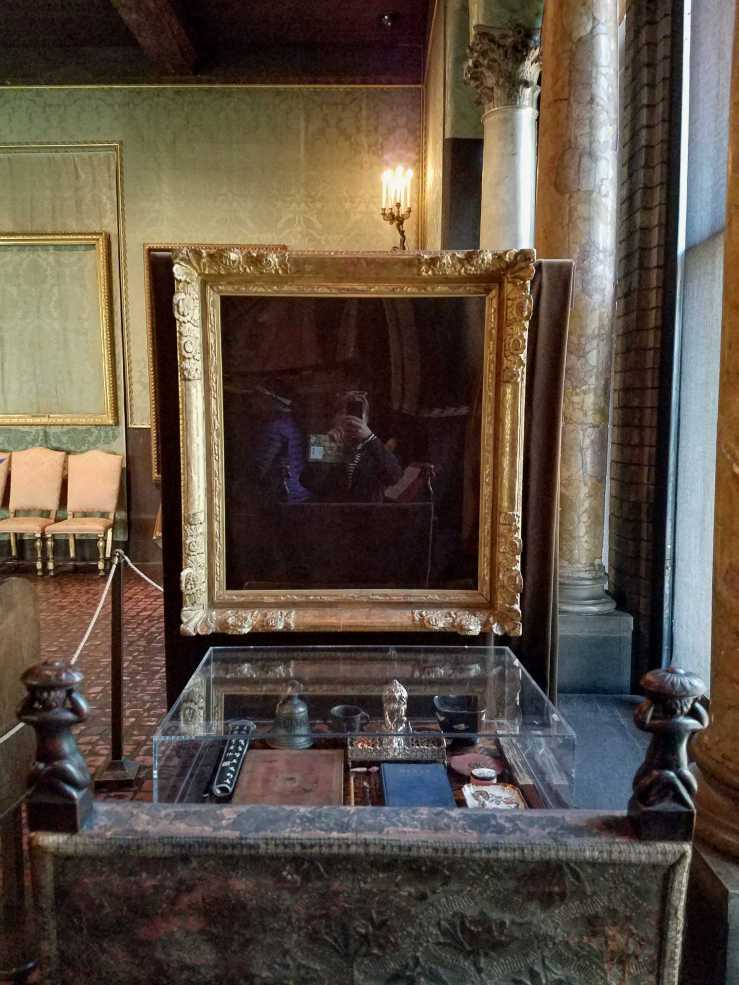
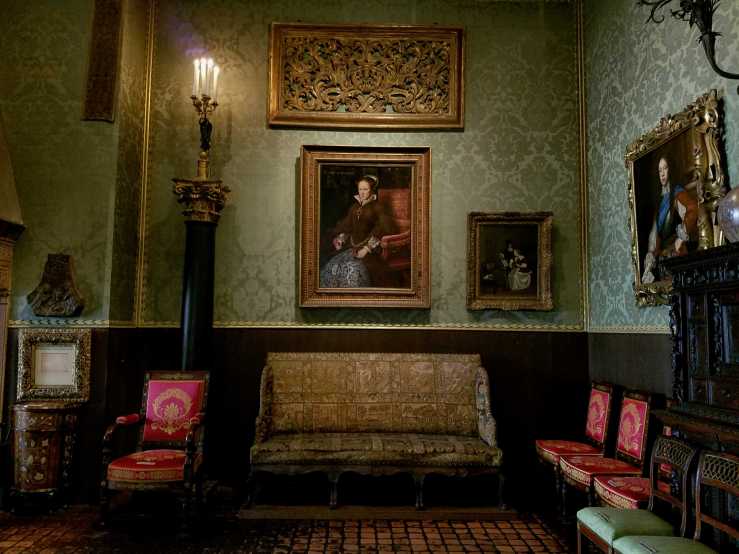
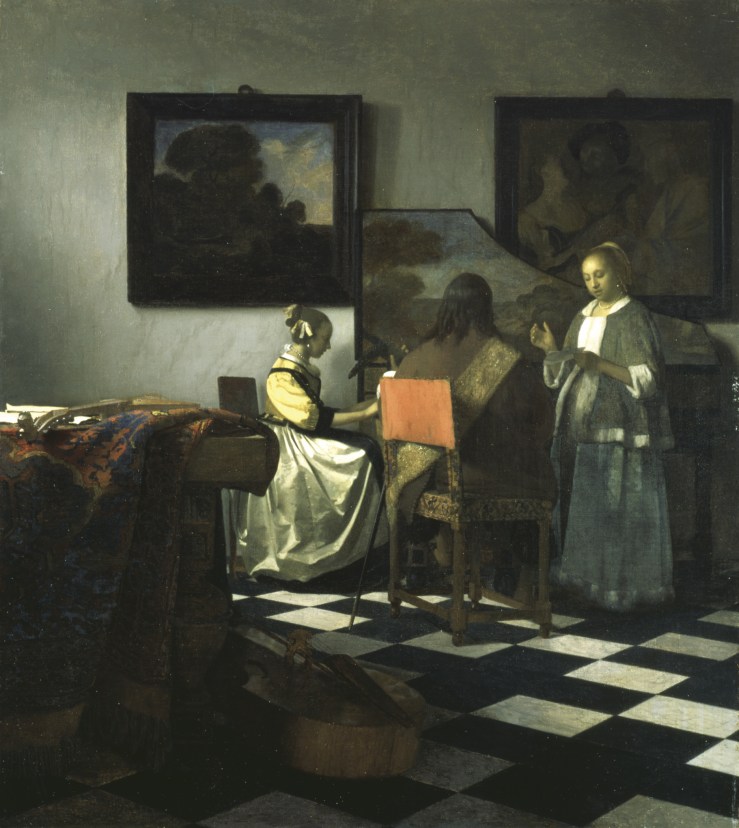
This is the Dutch Room, on the second floor.  Six works of art were stolen from here, including a Rembrandt self-portrait; one of his finest narrative paintings, A Lady and Gentleman in Black; and his only seascape, Christ in the Storm on the Sea of Galilee; as well as Johannes Vermeer’s The Concert.

Empty frames remain in their original position, awaiting for the art to return.

This is where Vermeer’s painting The Concert stood. One of only 36 by Vermeer in existence, this is the most valuable stolen painting—and perhaps the most valuable stolen object—in the world.

Isabella Gardner purchased The Concert in 1892 at auction in Paris. 

The Concert (c. 1664)
Johannes Vermeer
Oil on Canvas 

Isabella Stewart Gardner Museum

May 4th, 2017

The Gardner, part II – Vatichino

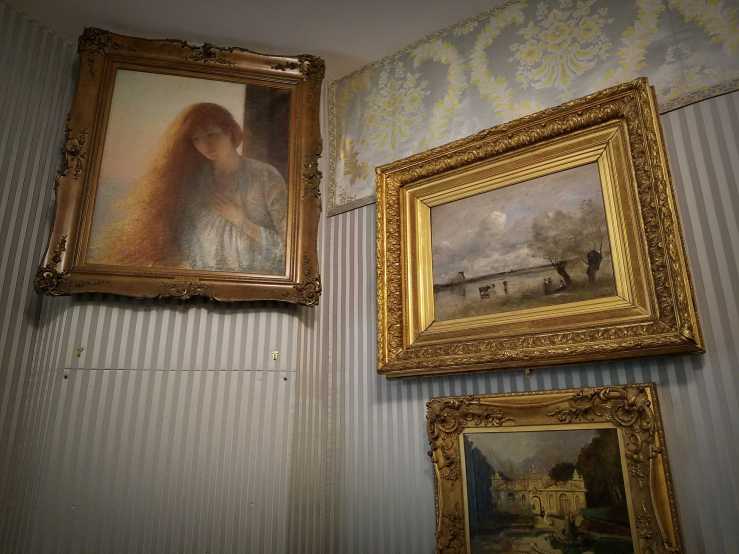
We continue our walk with a brief stop by the Blue Room, one of the most intimate and personal spaces, with objects that reflect Isabella’s personal relationships. In the early days of the Museum the Blue Room welcomed concert goers, serving as the ladies’ reception area. We stop long enough to throw envious stares at the luxurious locks of the lady depicted in Howard Gardiner Cushing’s – aptly named – painting ”The Shower of Gold” (1908).

Next, we enter the ”Vatichino” (the Little Vatican), a small and narrow room, thus named teasingly by Isabella precisely because it is so tiny.

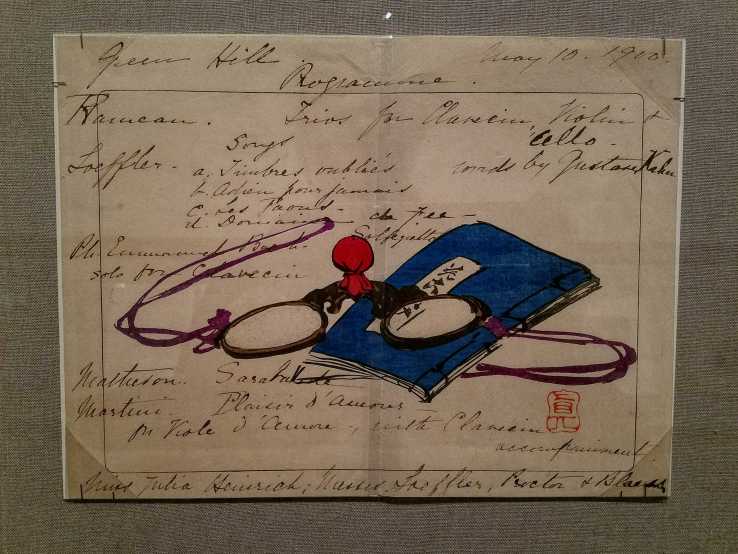
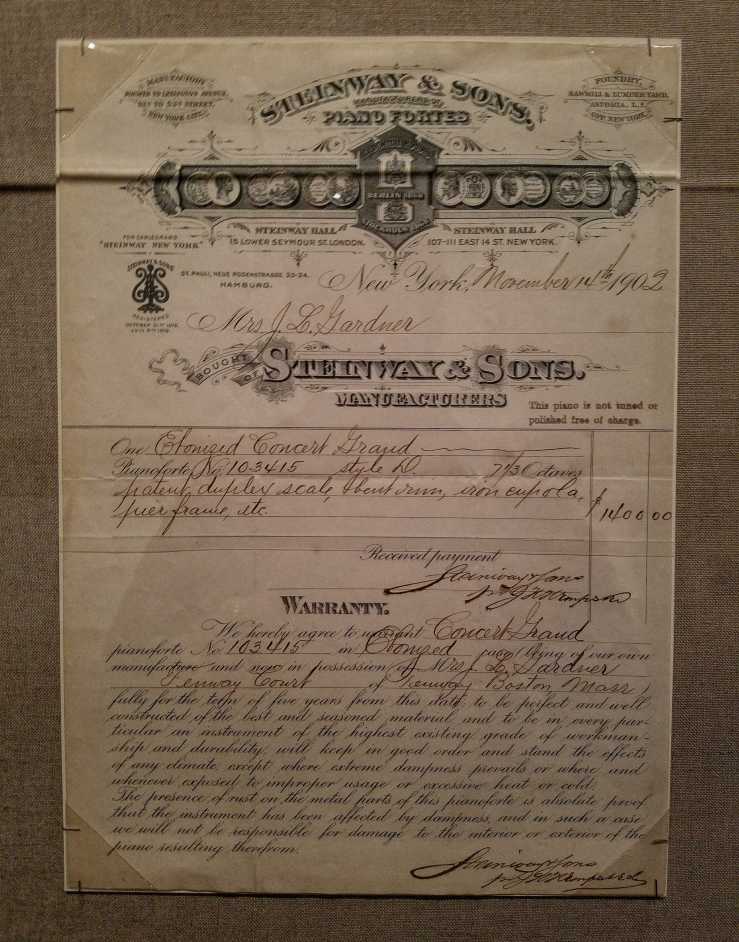
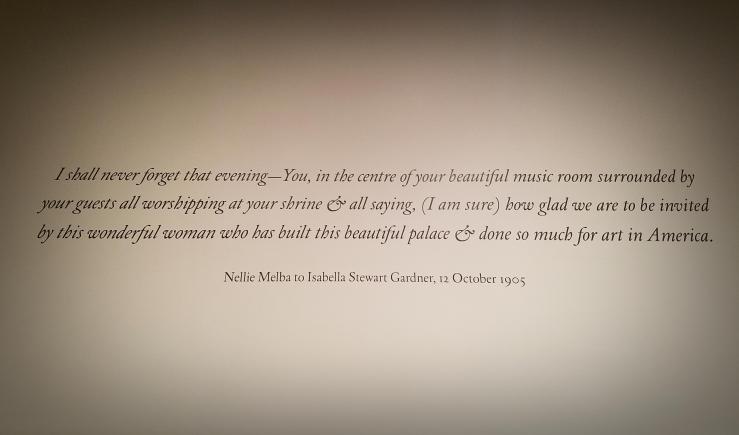
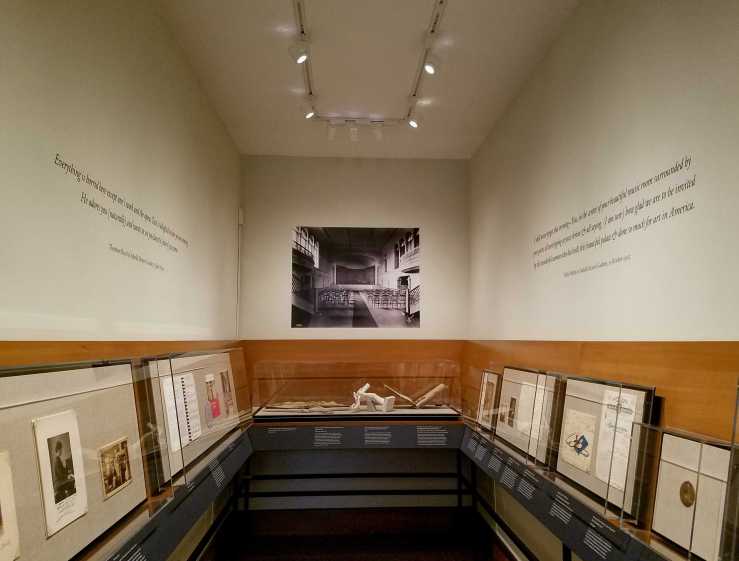
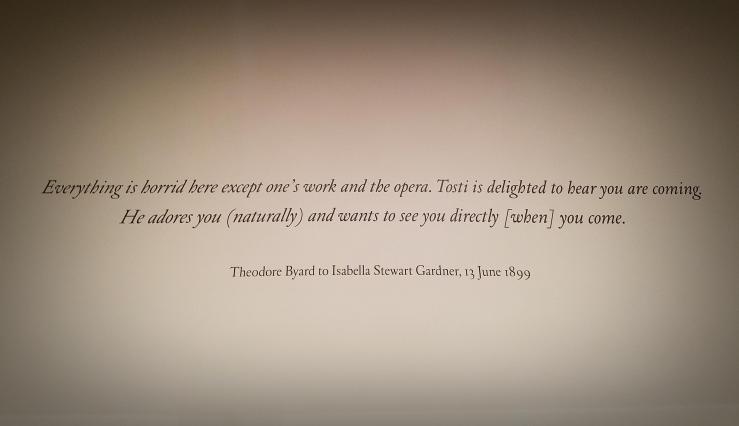
Here we can enjoy a collection of objects related to Gardner’s lifelong love of music.  ”An avid traveler, her musical tastes were shaped by experiences around the world. In diaries and letters, Gardner described the sounds of different cultures – from the soaring voices of the Bayreuth Festival in Germany to the raucous singing of boatmen on the Nile. When in Boston, Gardner regularly invited friends and family to concerts at her home, often printing beautiful programs for her guests.”

Program for a concert, 10 May 1900
Ink on polychrome Japanese woodblock print

”At her homes in Boston and Brookline, Gardner hosted musical performances and concerts for a range of audiences. While they were private events, they set an important precedent to the public musical performances that would be hosted at her museum after 1903. This program for a concert at her Brookline estate, which as known as Green Hill, features work by her friend Charles Martin Loeffler.”

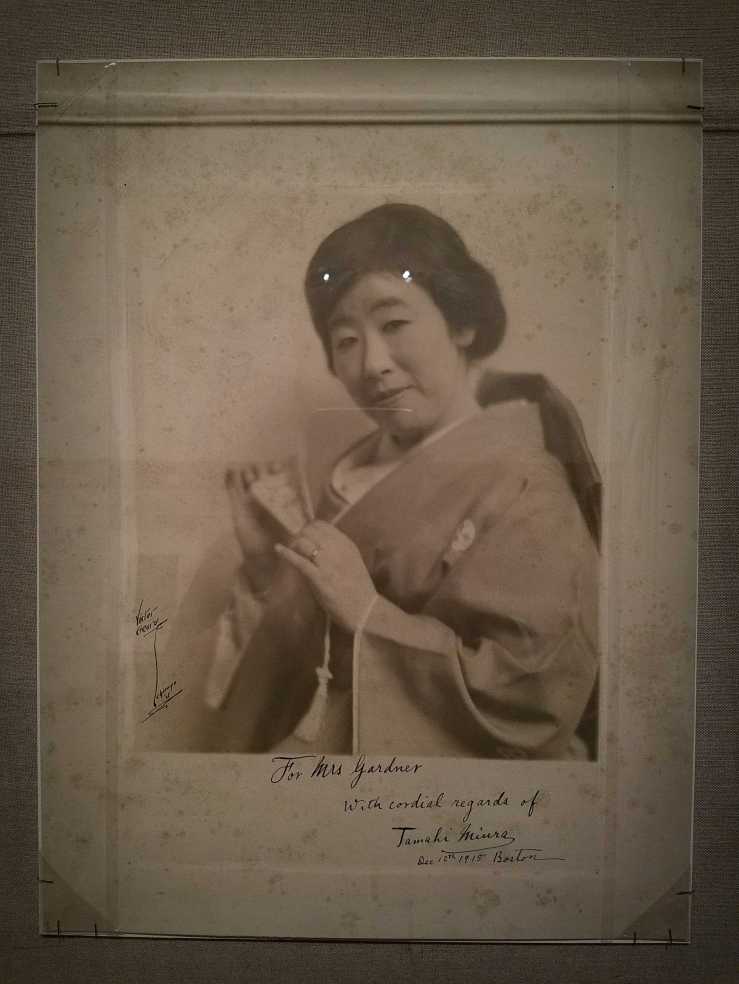
Victor George (active early 20th century)
Tamaki Miura, 1915
Platinum Print

”Tamaki Miura was the first internationally celebrated Japanese soprano. After training in her native Japan and in Europe, Miura was cast in the title role of Puccini’s Madama Butterfly in London in 1915. Acclaimed for her performances, Miura toured the United States to reprise her role for American audiences. Gardner was a great fan of the opera and friend to many singers; the fact that she collected a photographic portrait of Miura denotes her admiration for the path-breaking soprano.”

The Isabella Stewart Gardner Museum

May 4th, 2017

The Fabulous Isabella Stewart Gardner Museum

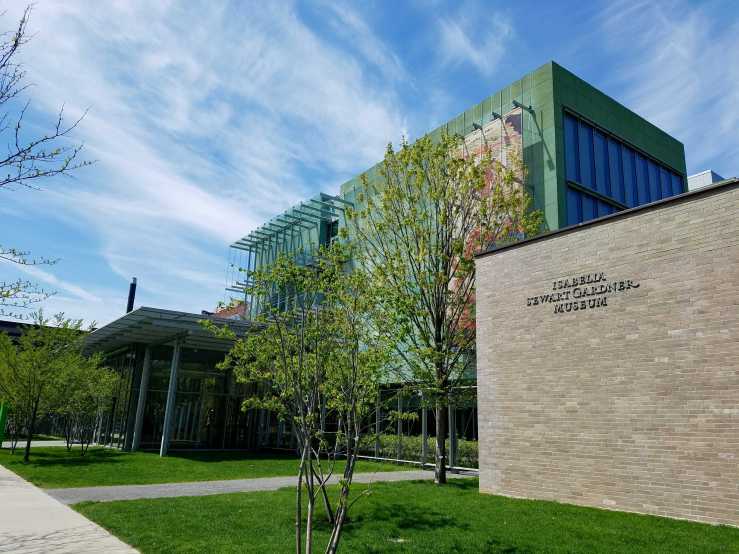
How come it is already one year ago this week, when we stepped into the secret world of wonders that is the Isabella Stewart Gardner Museum? That eclectic structure, inspired by Venetian Palazzos but integrating Roman, Byzantine, Romanesque, Gothic and Renaissance elements – and more recently a new glass wing by (you guessed it, again) Renzo Piano –  and still managing to look harmonious?

Indeed, Isabella and her husband Jack, loved Venice so much they wanted to bring it back home with them. And so they did! They bought columns, windows, and doorways to adorn every floor, as well as reliefs, balustrades, capitals, and statues.

But it was not just Venice. The Gardners travelled all over the world, from Paris to the Middle East, Egypt to the Far East and across America, collecting on their way paintings, photos, statues and other objects of art and craft. Their collection grew so big, the Gardners had to think about a new home for their treasures. That’s when plans for a new museum were first laid. But Jack’s sudden death in 1898 found Isabella pursuing their common dream all by herself.

And she certainly pursued it. Not only she was present at the site every day, she gave orders, demonstrated exactly how she wanted the building to look like down to the slightest detail. When ceiling beams arrived for the Gothic Room and were too smooth for her liking, she took an ax in hand and hacked away to achieve the desired result.

It took us the best part of the day to walk through The Gardner; it will take us a good full week to revisit it here on The Humble Fabulist. I hope you enjoy this series as we take a look into the wonderful world that Isabella Stewart Gardner built for us.

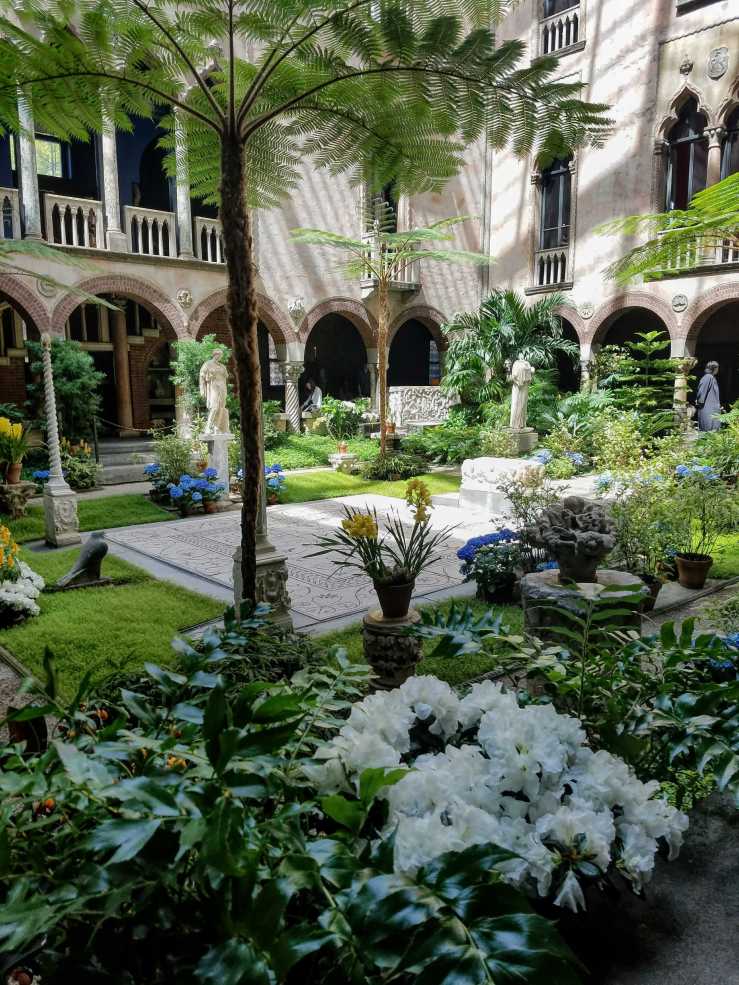
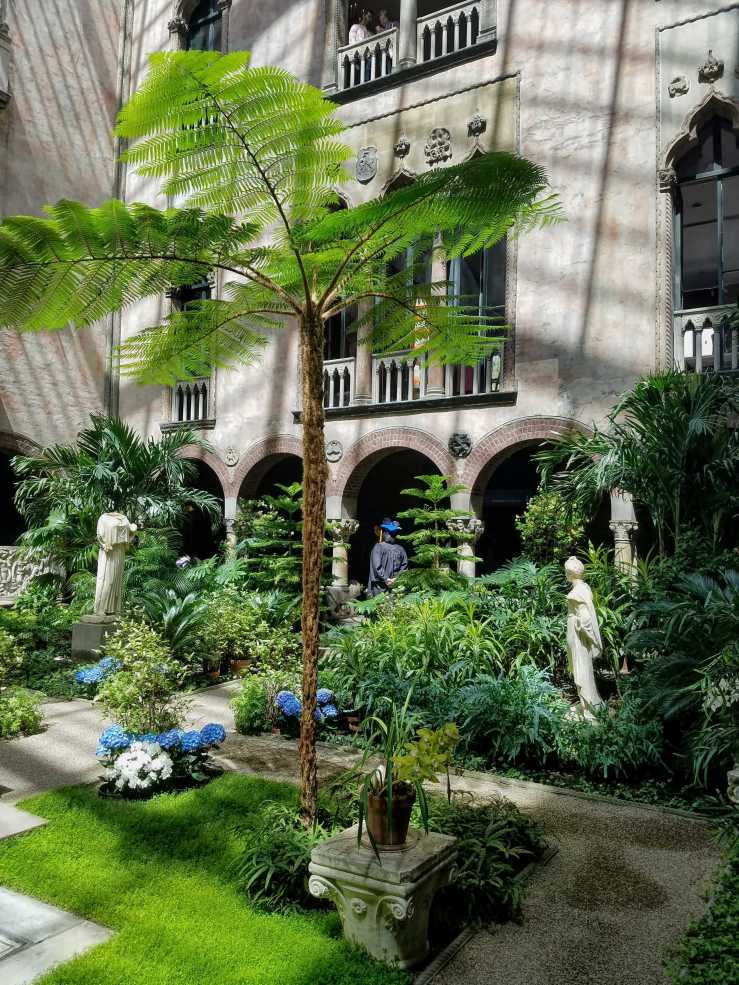
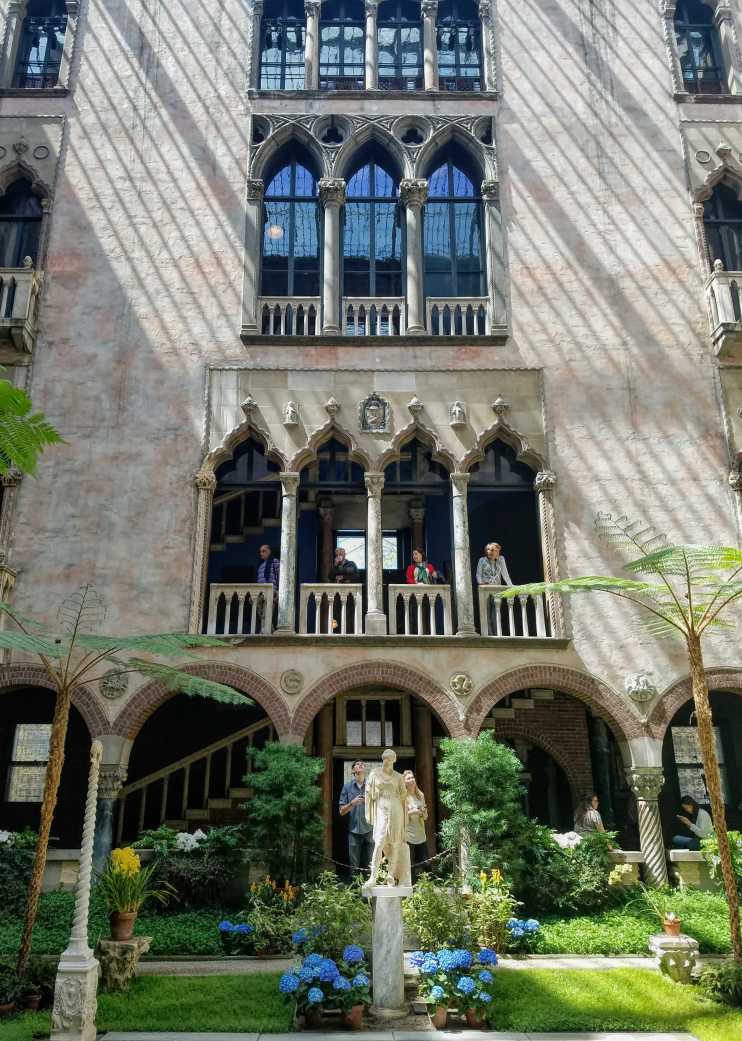
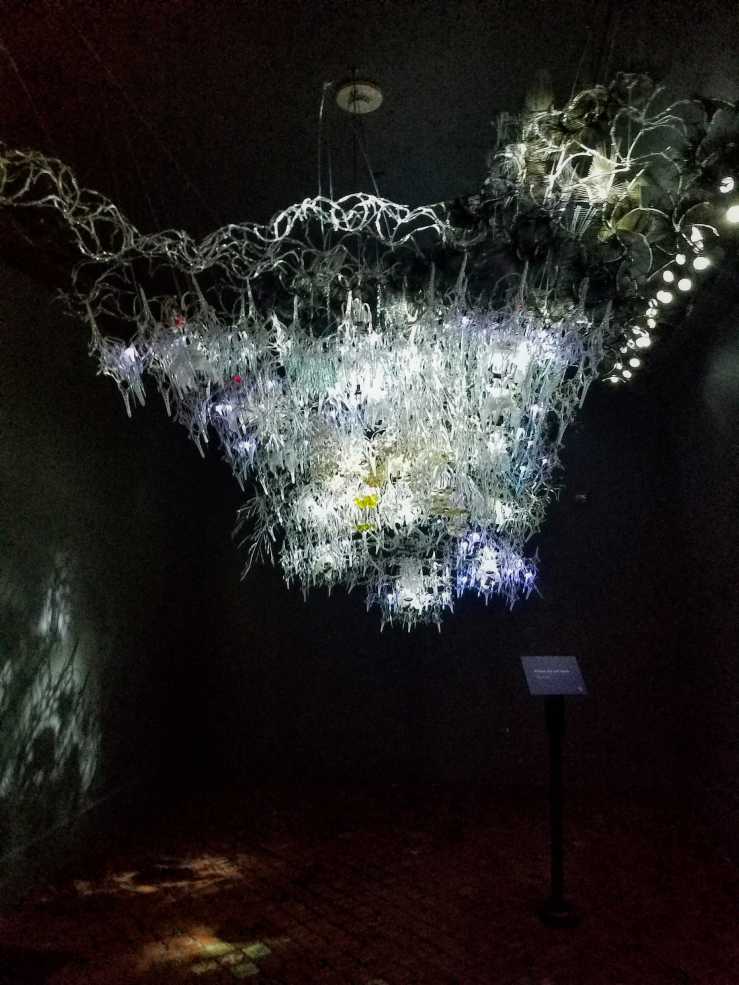
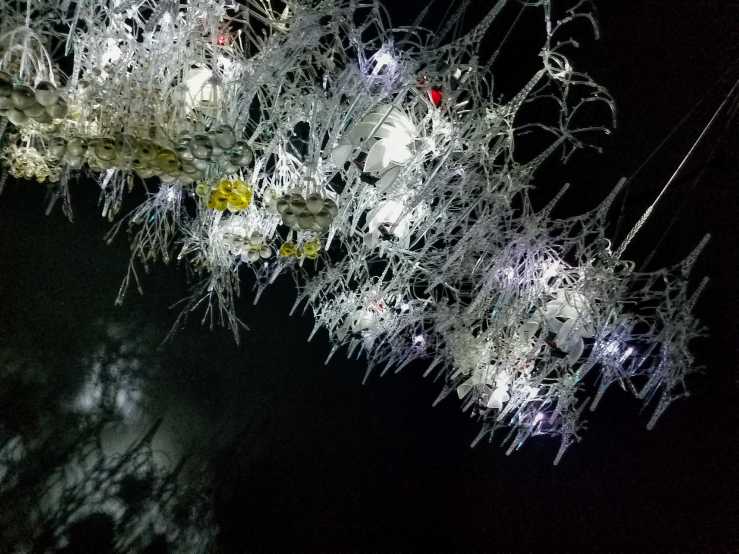
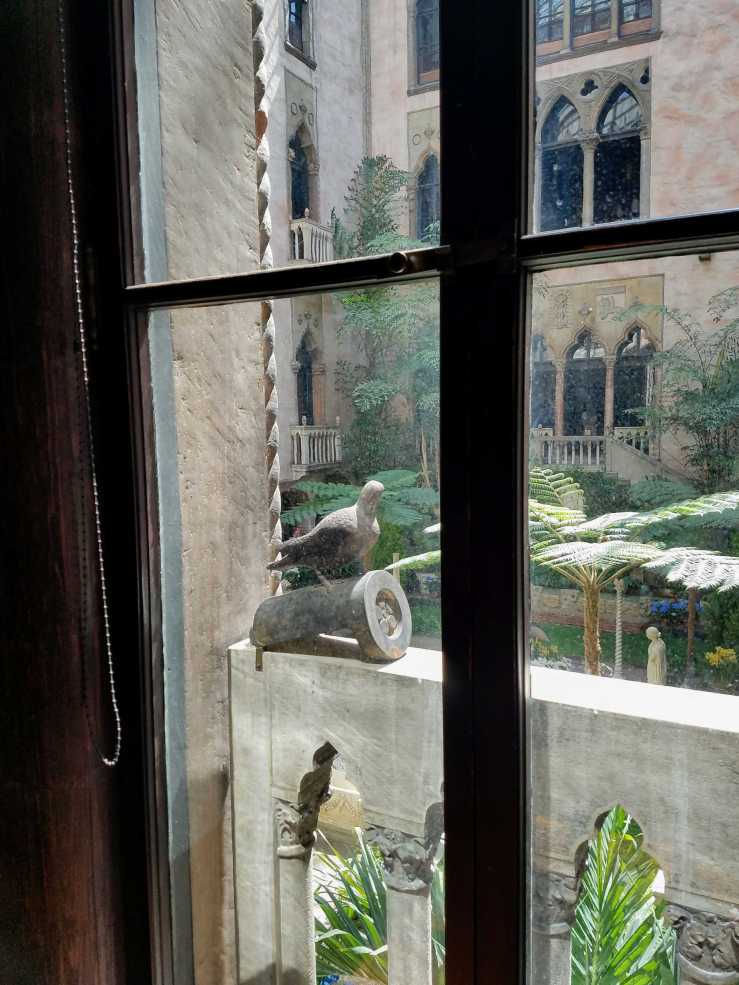
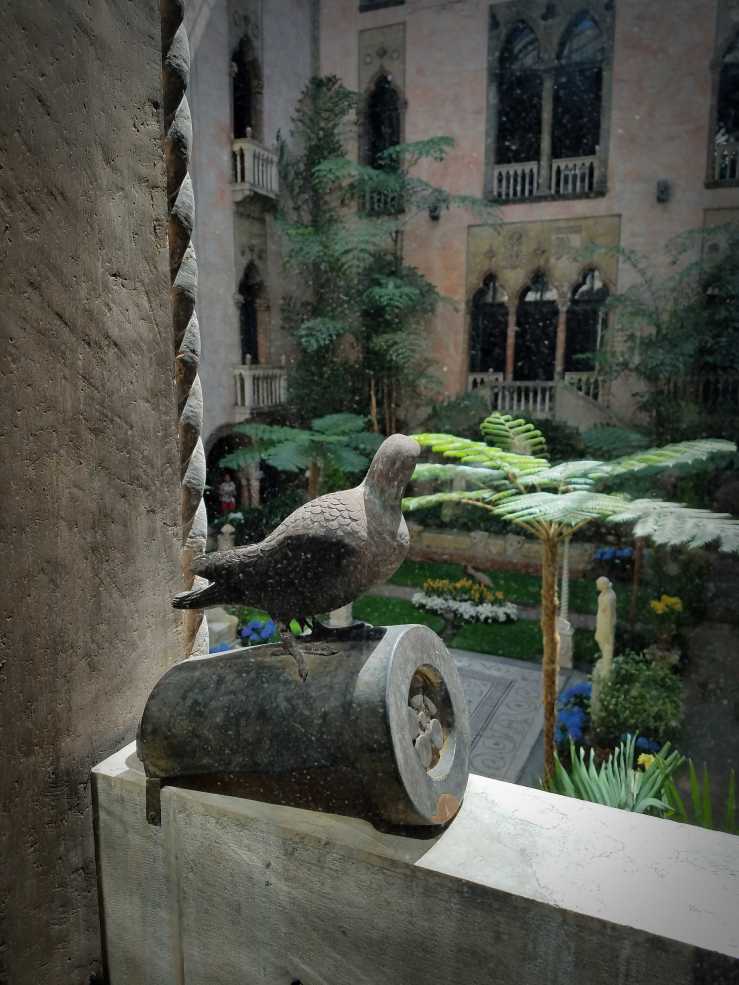
Let us start with the Courtyard, visible from every gallery in the museum, with its Ca’d’Oro balconies dating from 1845-1855 and Roman sculpture garden where plants change almost every month. For most of the them are grown in the Museum’s temperature-controlled Hingham greenhouses, then trucked here on rotation so that the garden is always in full bloom. Notice the hydrangeas in these pictures?  They are often grown from cuttings taken the previous year and are on view between May & June.  This is ”Sentient Veil”, a sculptural sound piece created in 2017, by Philip Beesley (b. 1956). Small glass ampules containing gold and blue liquids hang in clusters from a digitally fabricated textile, along with LED lighting and miniature acoustic resonators. “Sentient Veil” is silent until visitors enter the gallery; movement in the room triggers a mixture of whispers, mechanical clicks and gentle tones, creating a quiet chorus.

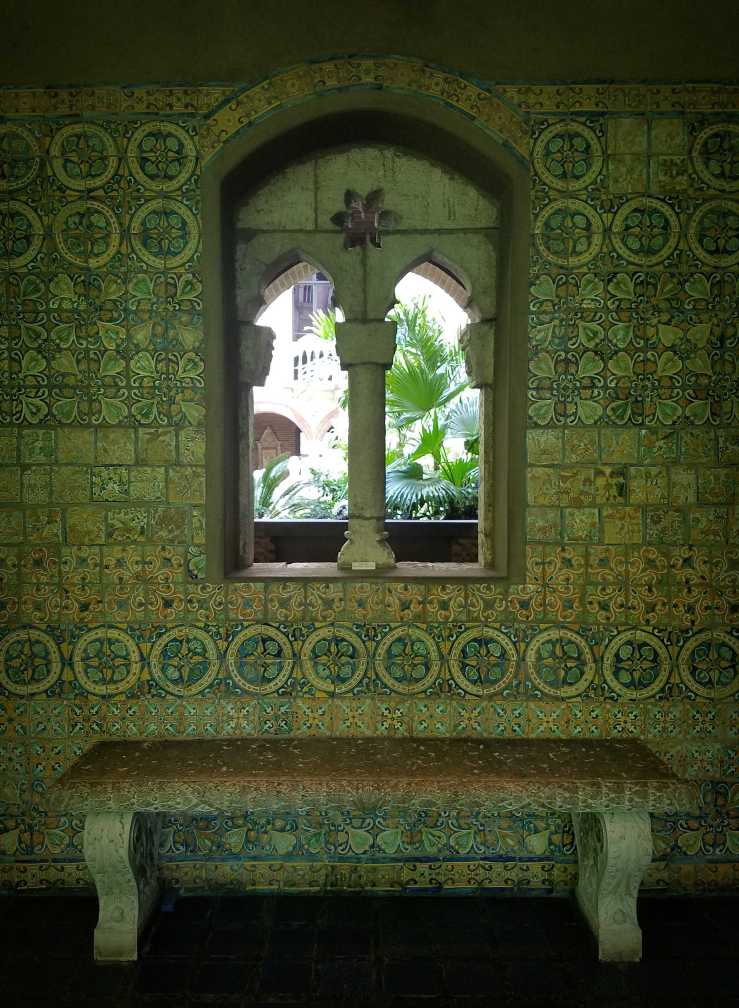
The Spanish Cloister –

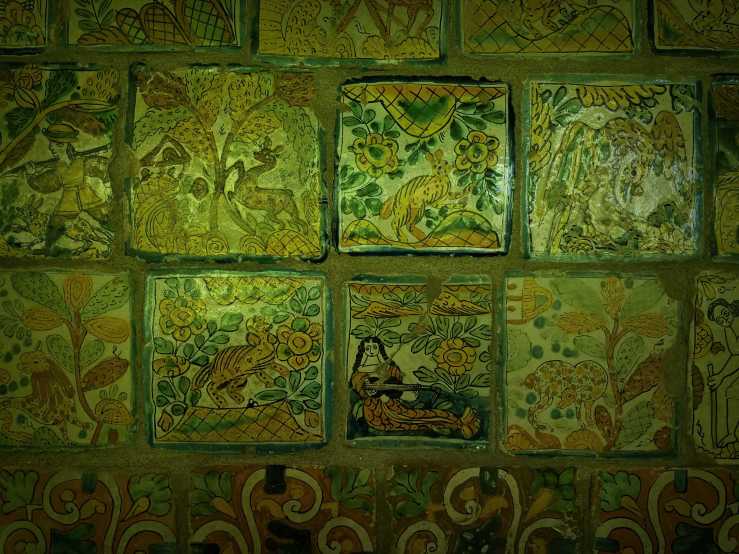
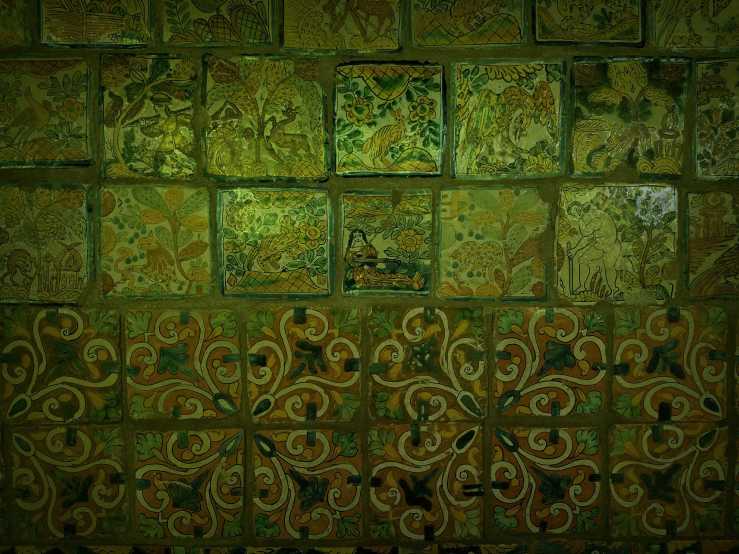
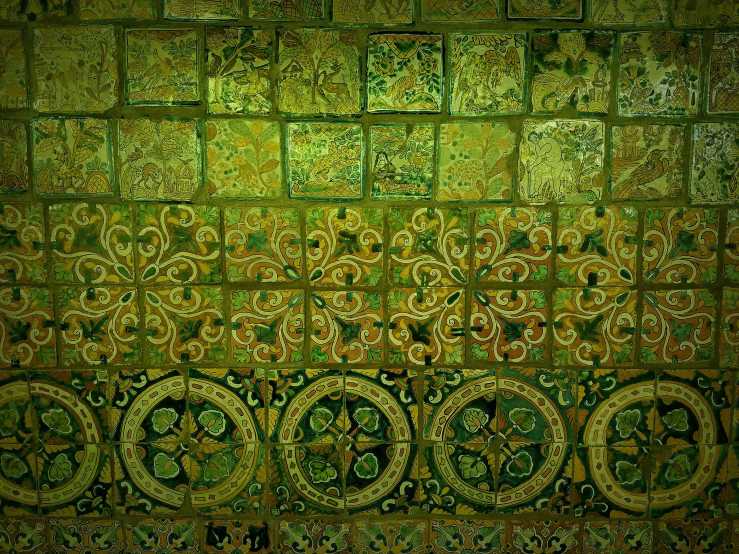
Isabella Gardner herself spent hours assembling the nearly 2,000 painted and glazed tiles into the appealing pattern we see today on the walls of the Spanish Cloister. Her friend, the artist Dodge Macknight, bought the tiles for her in Mexico in 1909 from the Church of San Agustìn.

And, finally for today,

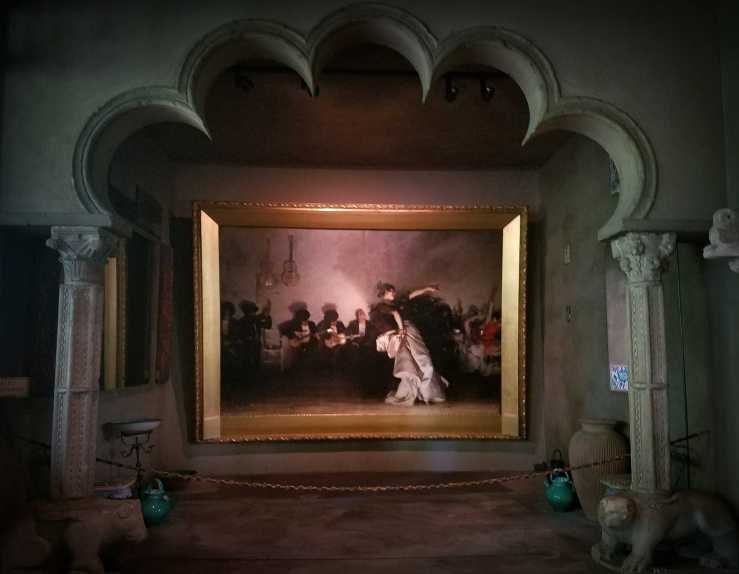
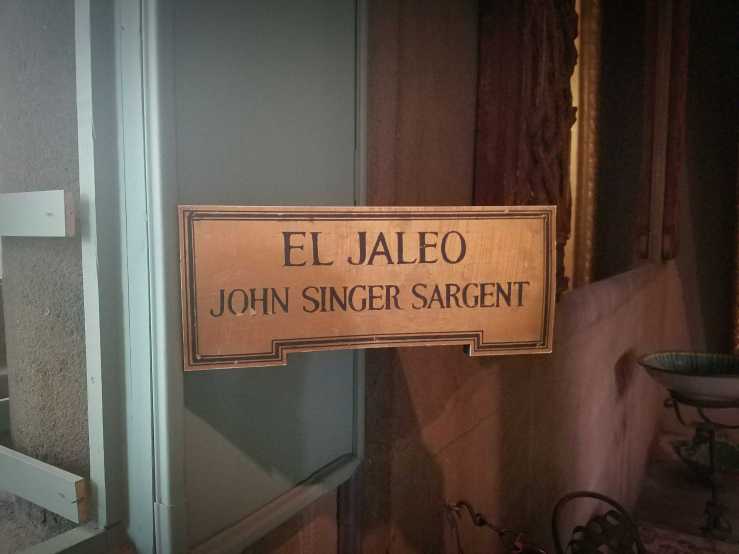
JOHN SINGER SARGENT (1856 – 1925)
EL JALEO, 1882
Oil on canvas

During his travels in Spain in 1879, Sargent was mulling over a major work of art in which he could express his love of Gypsy music, dance, and picturesque costumes. On his return to Paris he set to work on a wide horizontal picture whose proportions simulated the shallow stage space of popular musical establishments. He named the painting El Jaleo to suggest the name of a dance, the jaleo de jerez, while counting on the broader meaning jaleo, which means ruckus or hubbub. The painting was exhibited at the Paris Salon of 1882 with the more explicit title El Jaleo: Danse des gitanes (Dance of the Gypsies).

The Isabella Stewart Gardner Museum

May 4th, 2017

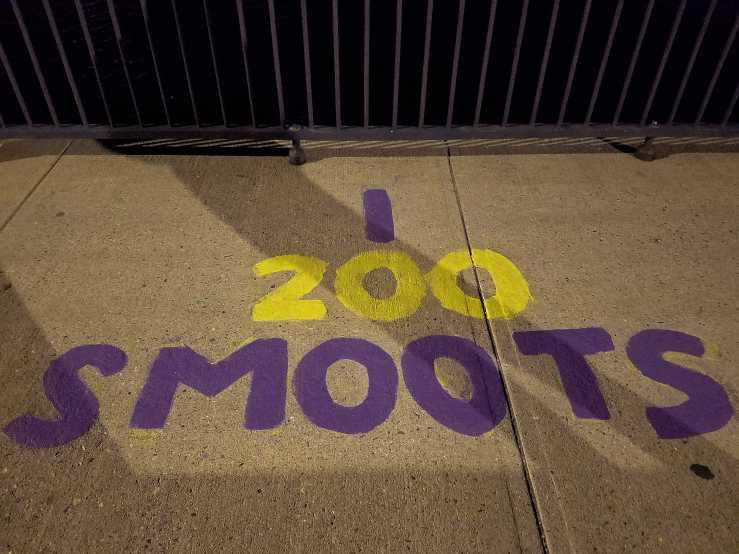
200 Smoots

200 Smoots?!?! What kind of measurement system is that? I wondered… So, I looked it up. Behold, my friends, the story of how ”Smoot as unit of Length” came to be:

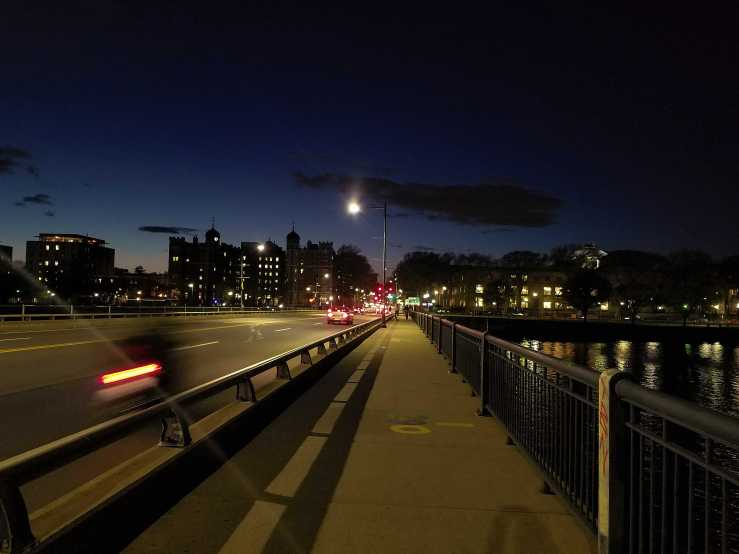
 “Harvard Bridge spans the Charles River linking Boston and Cambridge.  In 1958 Lambda Chi Alpha took 5′ 7” MIT freshman pledge Oliver R. Smoot, Jr. and rolled him head over heels the entire length of the bridge.  Every ten smoots they calibrated the bridge, painting marks. The bridge was found to be exactly 364.4 smoots plus an ear.  Successive pledge classes repainted the markings.

In 1987 the Mass. Dept. of Public Works decided the concrete of the bridge was due for replacement.  They had no plans for smoot preservation.  The Boston Press tracked down Oliver R. Smoot, Jr. who was then age 48, and executive vice president of Computer and Business Equipment Manufactures Association in Washington D. C.  He had no plans of being reused for new markings.

The Mass. Metropolitan District Commission, the government body in charge of the bridge went on record in support of smoots.  They stated, “We recognize the smoots’ role in local history.  That’s not to mean that the agency encourages graffiti painting.  But smoots aren’t just any kind of graffiti.  They’re smoots!  If commemorative plaques and markers are not installed by the state once the bridge work is done, then we’ll see that it’s done.”

Stephen Smoot, a son of Oliver R. Smoot, Jr, was then age 21 and attending MIT was ready to redo the smoot measurements, although he was 5’11”, so everything would be off.

There are a couple of pictures of Oliver R. Smoot, of MIT students ready to redo measurements with Stephen Smoot, and of a plaque that reads: 
“This plaque place in honor of THE SMOOT which joined the angstrom, meter and light year as standards of length, when in October 1958 the span of this bridge was measured, using the body of Oliver Reed Smoot, M.I.T. ’62 and found to be precisely 364.4 smoots and one ear.  Commemorated at out 25th reunion June 6, 1987 M.I.T. Class of 1962”

Another clipping states that the Mass. Dept. of Public Works gave two Smooted sections of sidewalk to the MIT museum at a ceremony.  Continental Construction Company of Cambridge also agreed to make the new concrete sidewalk slabs 5′ 7″ long to coincide with the Smoots, instead of the usual 6′ increments.”

End of SMOOT-D Digest V99 Issue #23

More about Mr. Smoots and his ear can be found here: x

Harvard Bridge, Boston

May 3rd, 2017


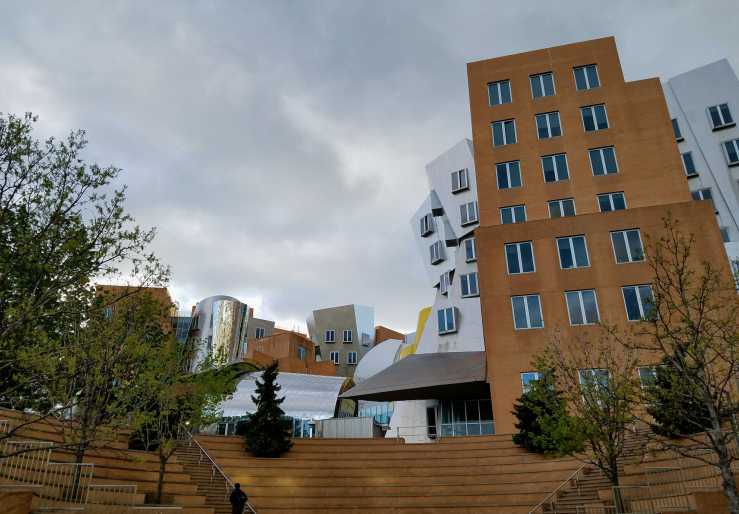
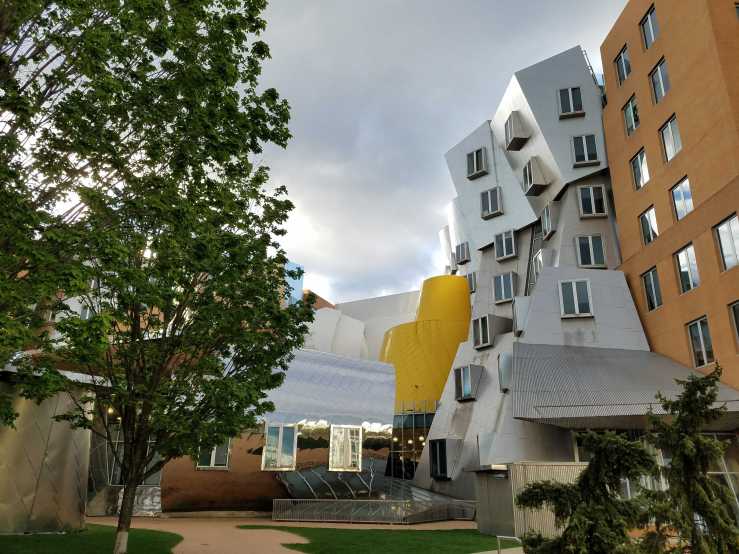
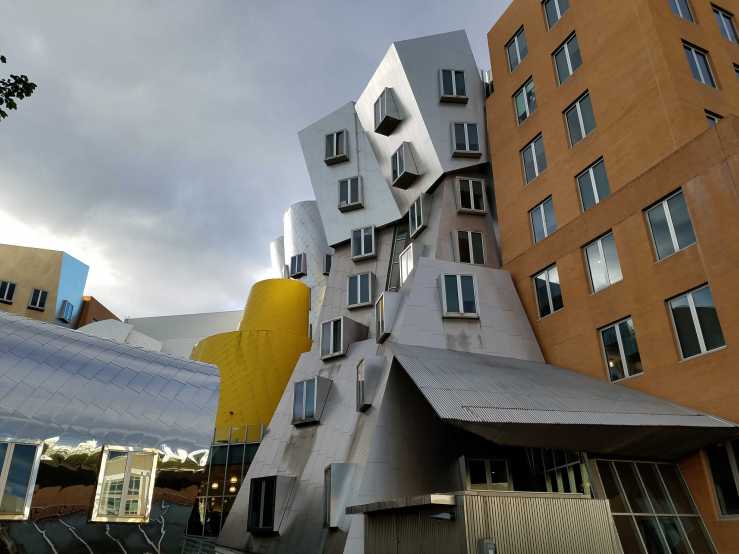
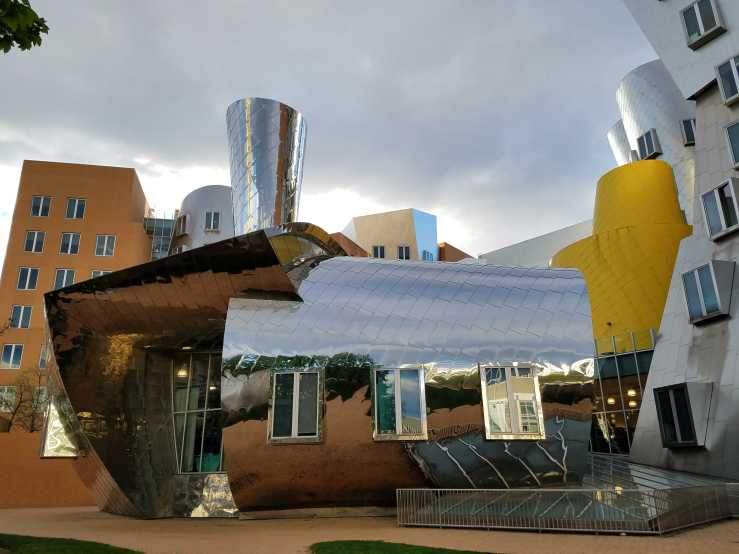
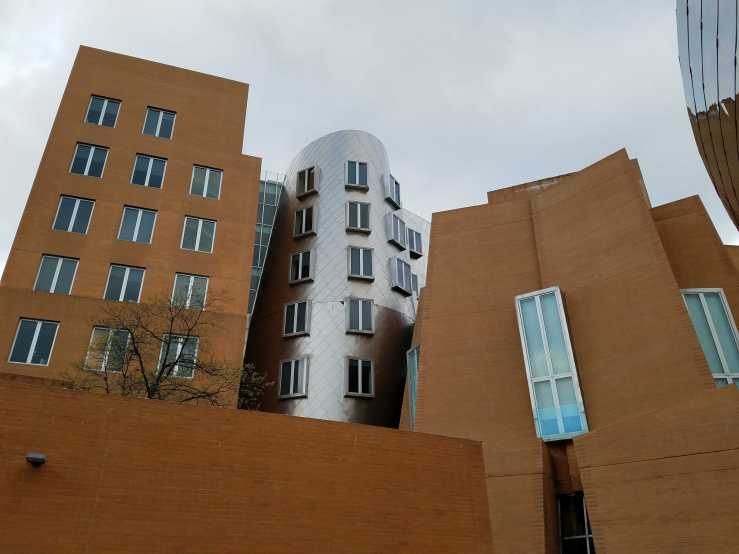
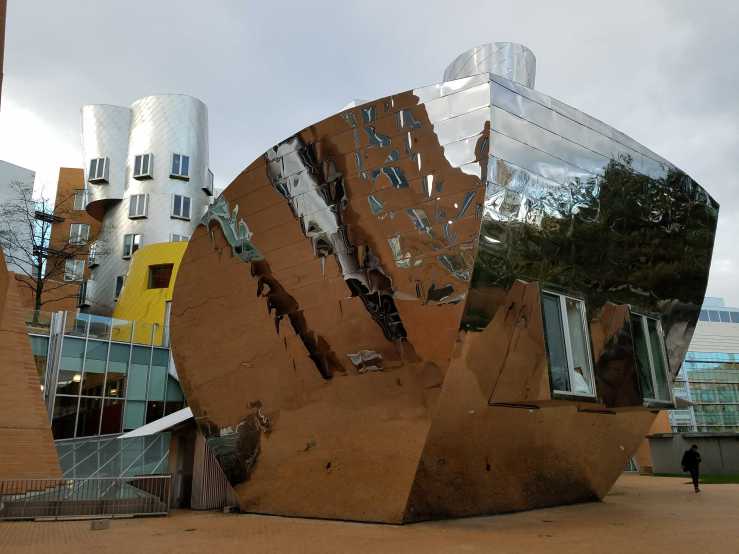
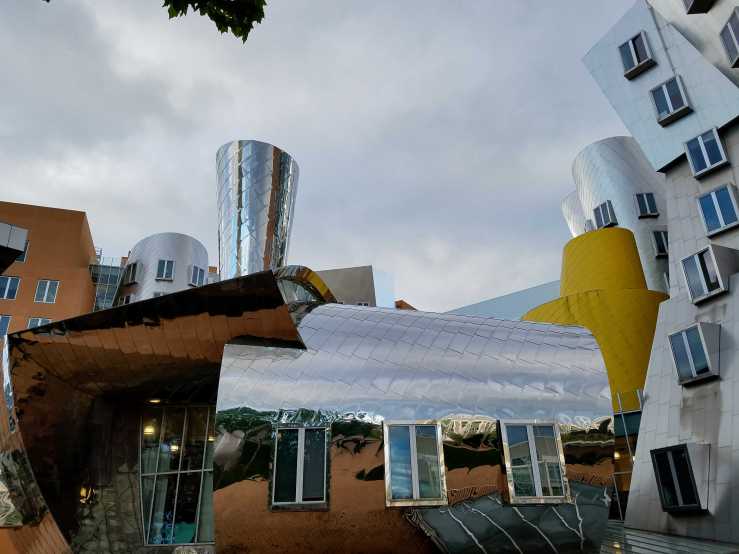
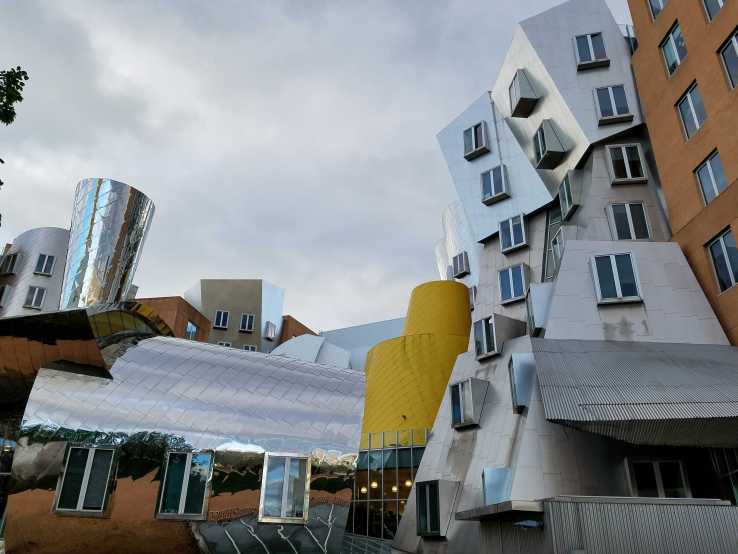
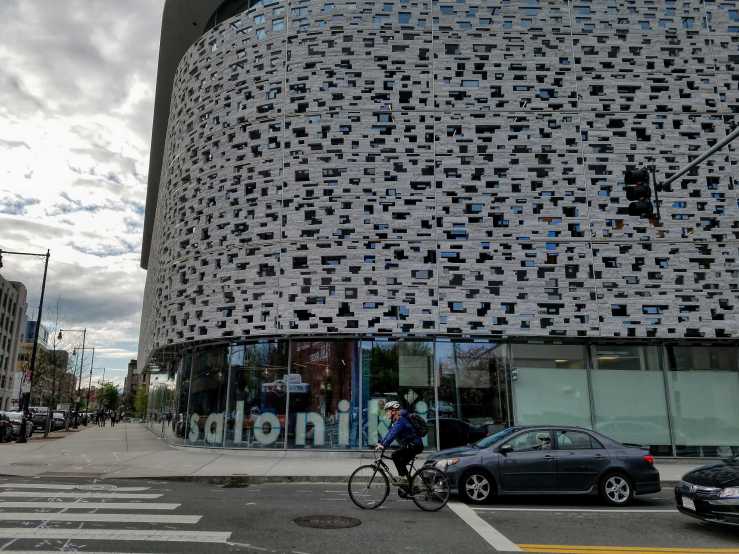
The Dancing House of MIT

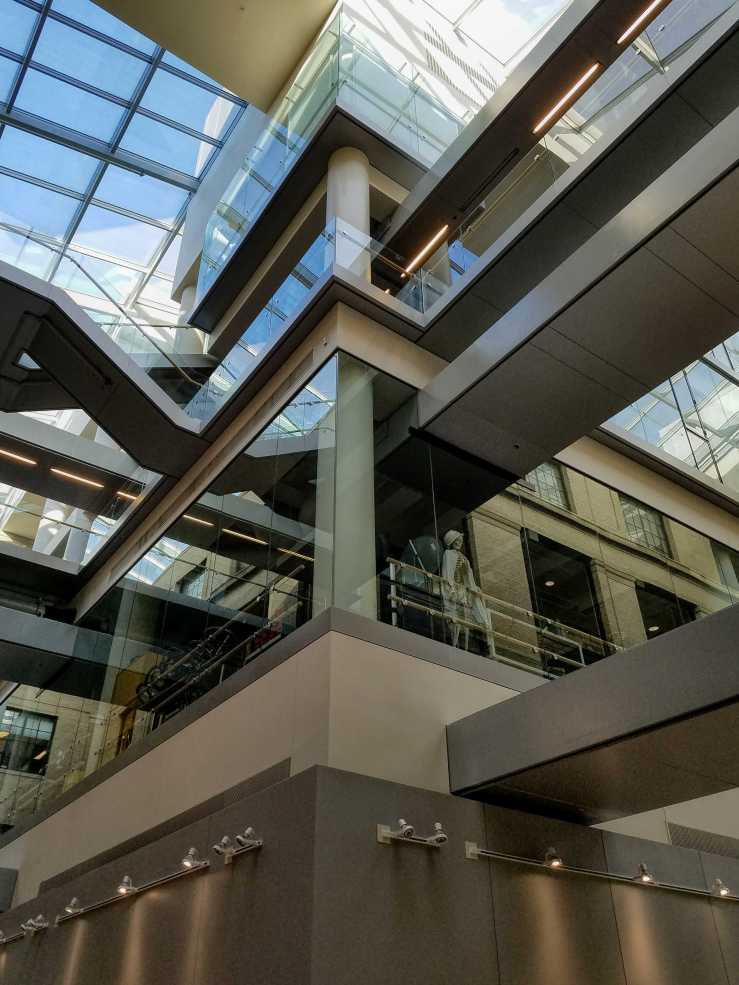
Or Building 32, as the Ray and Maria Stata Center is widely known, in accordance with the MIT custom of referring to buildings by their numbers.

This quaint, norm-defying construction is home to the Computer Science and Artificial Intelligence Laboratory (CSAIL), the Laboratory for Information and Decision Systems (LIDS) and the Department of Linguistics and Philosophy. Designed by none other than Mr. Frank Gehry, mastermind of some of the most spectacular buildings in the world, including the other dancing house, that intrigues visitors in Prague, Czech Republic, since 1996. Love it or hate it, it certainly is a show-stopper. Now… are you ready to dance?

May 3rd, 2017

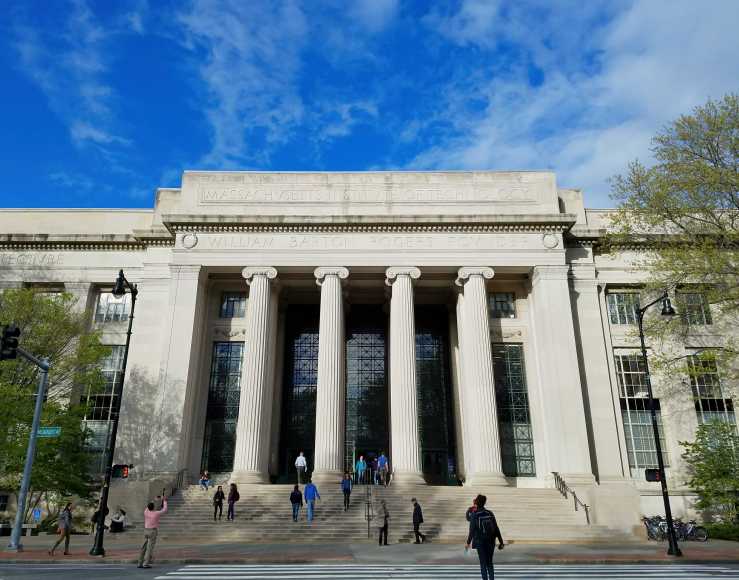
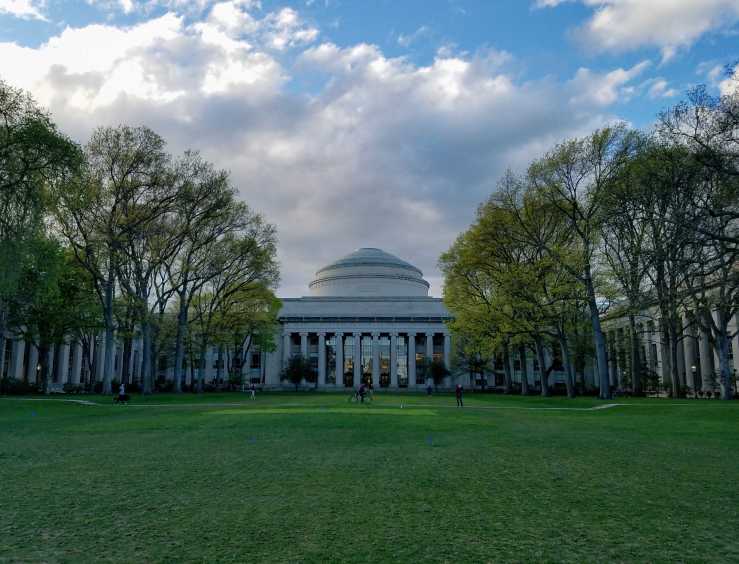
The Massachusetts Institute of Technology

Affectionately, MIT.

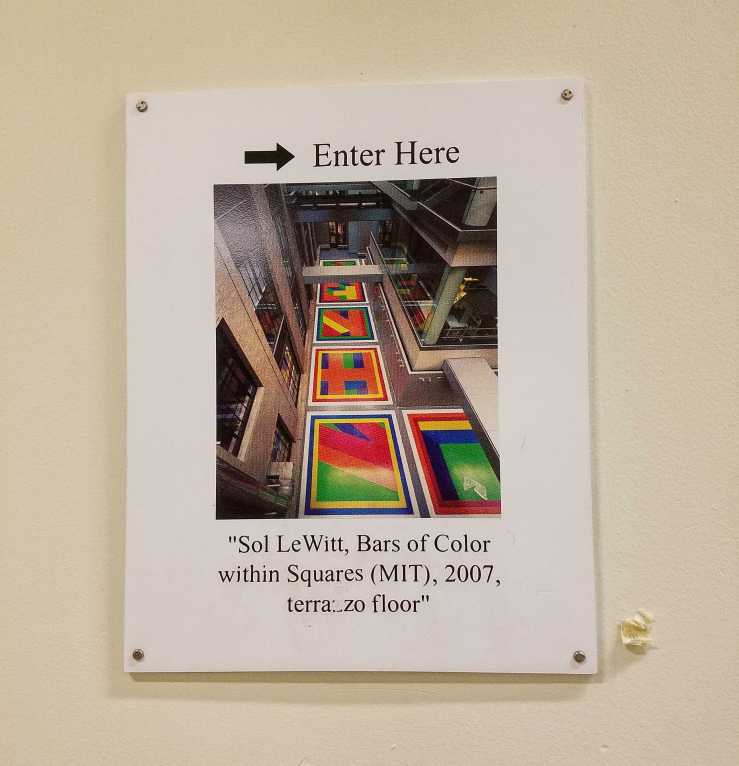
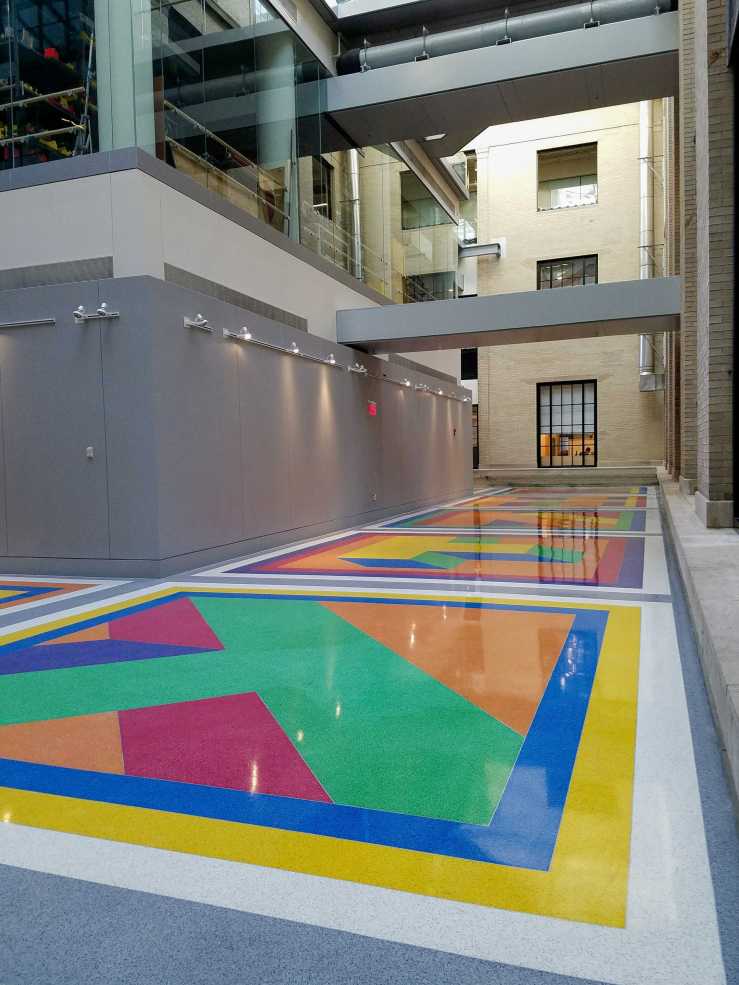
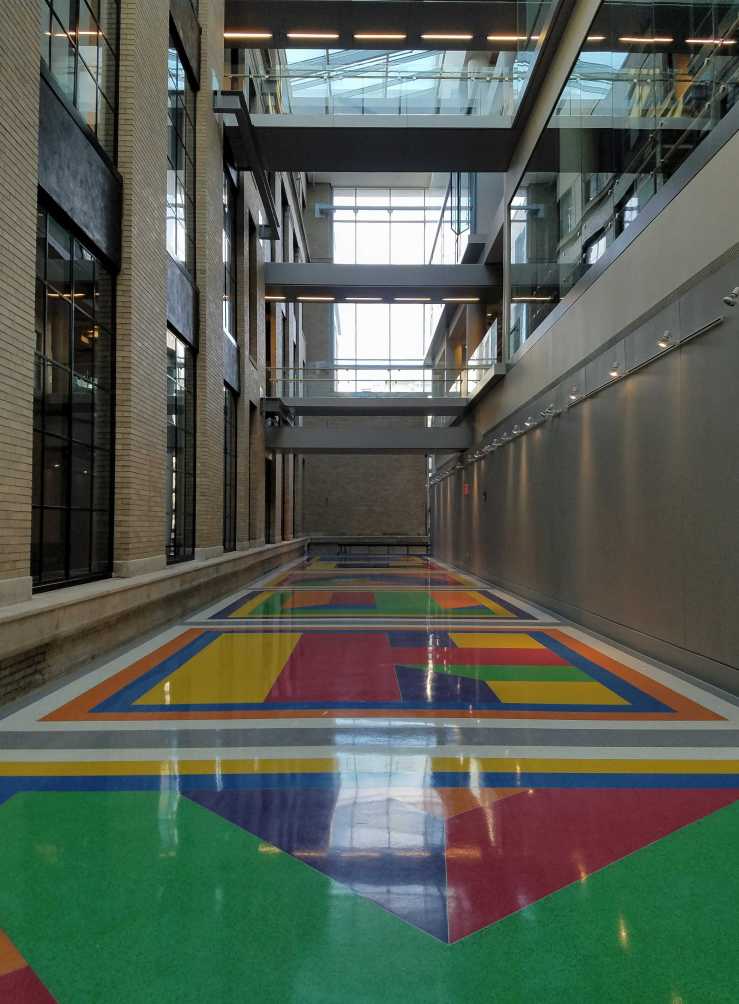
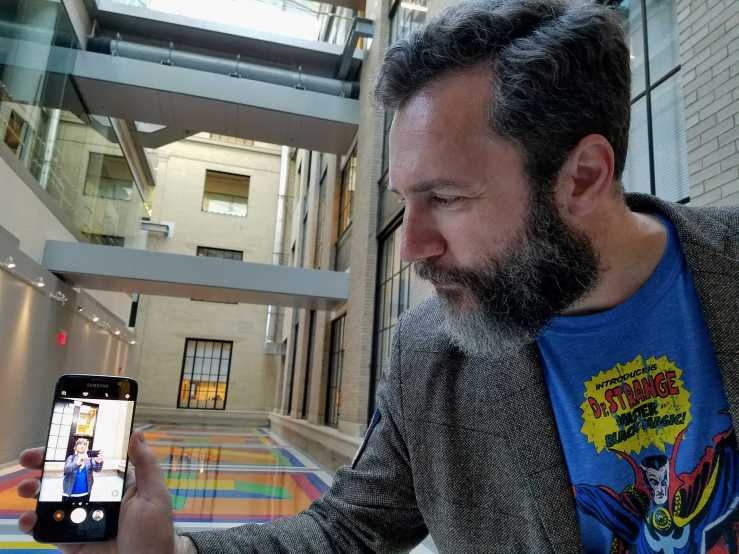
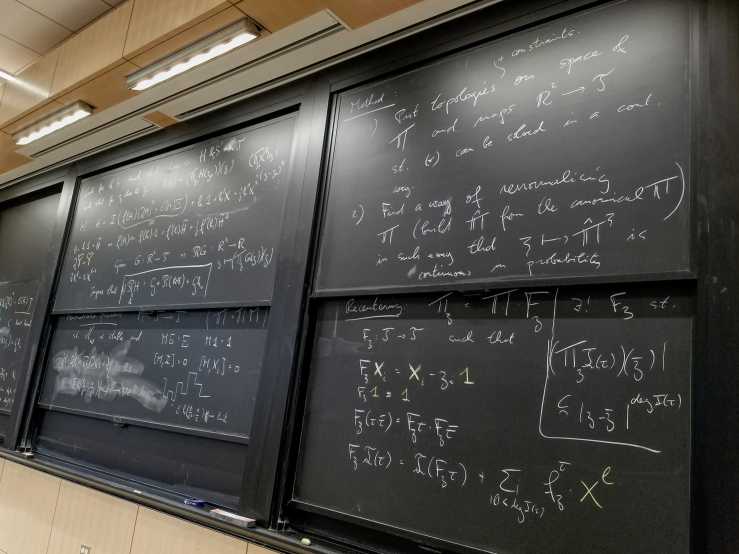
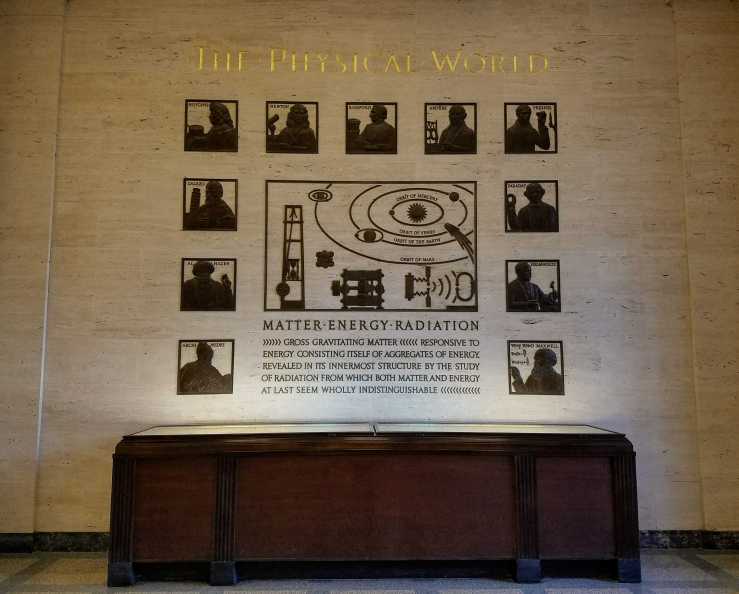
Where the art of uncovering the mysteries of physical sciences meets with the determination and positive energy of the bright young things of today, groomed to become some of the most distinguished scientists and entrepreneurs of tomorrow. The MIT is not only infusing knowledge into the minds of students, it is educating game-changers. If the MIT were a car, it would have been a Tesla. In fact, I wouldn’t have been surprised had I’d seen one roaming about the premises. I was more taken aback by the monumental work by Sol LeWitt covering an entire corridor. Universities don’t get any cooler than this.

Sentences on Conceptual Art, by Sol Lewitt

  1. Conceptual artists are mystics rather than rationalists. They leap to conclusions that logic cannot reach.
  2. Rational judgements repeat rational judgements.
  3. Irrational judgements lead to new experience.
  4. Formal art is essentially rational.
  5. Irrational thoughts should be followed absolutely and logically.
  6. If the artist changes his mind midway through the execution of the piece he compromises the result and repeats past results.
  7. The artist’s will is secondary to the process he initiates from idea to completion. His wilfulness may only be ego.
  8. When words such as painting and sculpture are used, they connote a whole tradition and imply a consequent acceptance of this tradition, thus placing limitations on the artist who would be reluctant to make art that goes beyond the limitations.
  9. The concept and idea are different. The former implies a general direction while the latter is the component. Ideas implement the concept.
  10. Ideas can be works of art; they are in a chain of development that may eventually find some form. All ideas need not be made physical.
  11. Ideas do not necessarily proceed in logical order. They may set one off in unexpected directions, but an idea must necessarily be completed in the mind before the next one is formed.
  12. For each work of art that becomes physical there are many variations that do not.
  13. A work of art may be understood as a conductor from the artist’s mind to the viewer’s. But it may never reach the viewer, or it may never leave the artist’s mind.
  14. The words of one artist to another may induce an idea chain, if they share the same concept.
  15. Since no form is intrinsically superior to another, the artist may use any form, from an expression of words (written or spoken) to physical reality, equally.
  16. If words are used, and they proceed from ideas about art, then they are art and not literature; numbers are not mathematics.
  17. All ideas are art if they are concerned with art and fall within the conventions of art.
  18. One usually understands the art of the past by applying the convention of the present, thus misunderstanding the art of the past.
  19. The conventions of art are altered by works of art.
  20. Successful art changes our understanding of the conventions by altering our perceptions.
  21. Perception of ideas leads to new ideas.
  22. The artist cannot imagine his art, and cannot perceive it until it is complete.
  23. The artist may misperceive (understand it differently from the artist) a work of art but still be set off in his own chain of thought by that misconstrual.
  24. Perception is subjective.
  25. The artist may not necessarily understand his own art. His perception is neither better nor worse than that of others.
  26. An artist may perceive the art of others better than his own.
  27. The concept of a work of art may involve the matter of the piece or the process in which it is made.
  28. Once the idea of the piece is established in the artist’s mind and the final form is decided, the process is carried out blindly. There are many side effects that the artist cannot imagine. These may be used as ideas for new works.
  29. The process is mechanical and should not be tampered with. It should run its course.
  30. There are many elements involved in a work of art. The most important are the most obvious.
  31. If an artist uses the same form in a group of works, and changes the material, one would assume the artist’s concept involved the material.
  32. Banal ideas cannot be rescued by beautiful execution.
  33. It is difficult to bungle a good idea.
  34. When an artist learns his craft too well he makes slick art.
  35. These sentences comment on art, but are not art.

First published in 0-9 (New York), 1969, and Art-Language (England), May 1969


May 3rd, 2017

That jagged red line

Our stop at the Harvard Art Museums was an enlightening and entertaining experience. Walking through the galleries with their surprisingly large and varied art collection, it is easy to forget that this is, first and foremost, a teaching institution. For the Museums’ collections and exhibitions may be admired by the art loving general public but their main purpose is to serve as catalysts for teaching and research projects and encourage active learning and thinking across disciplines and cultures.

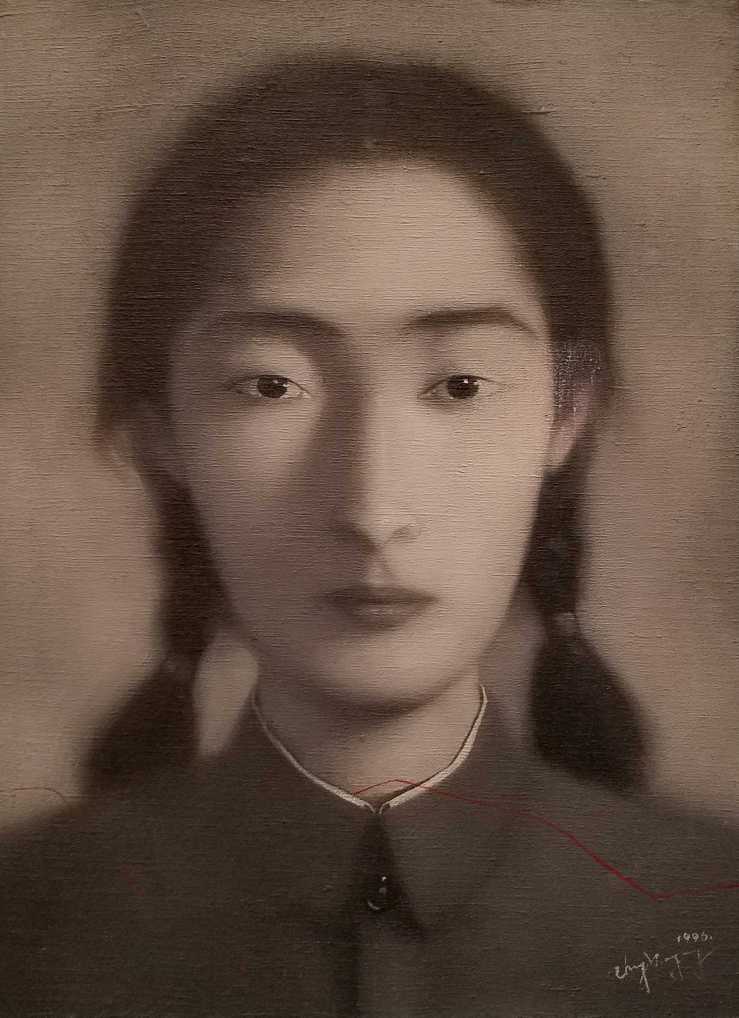
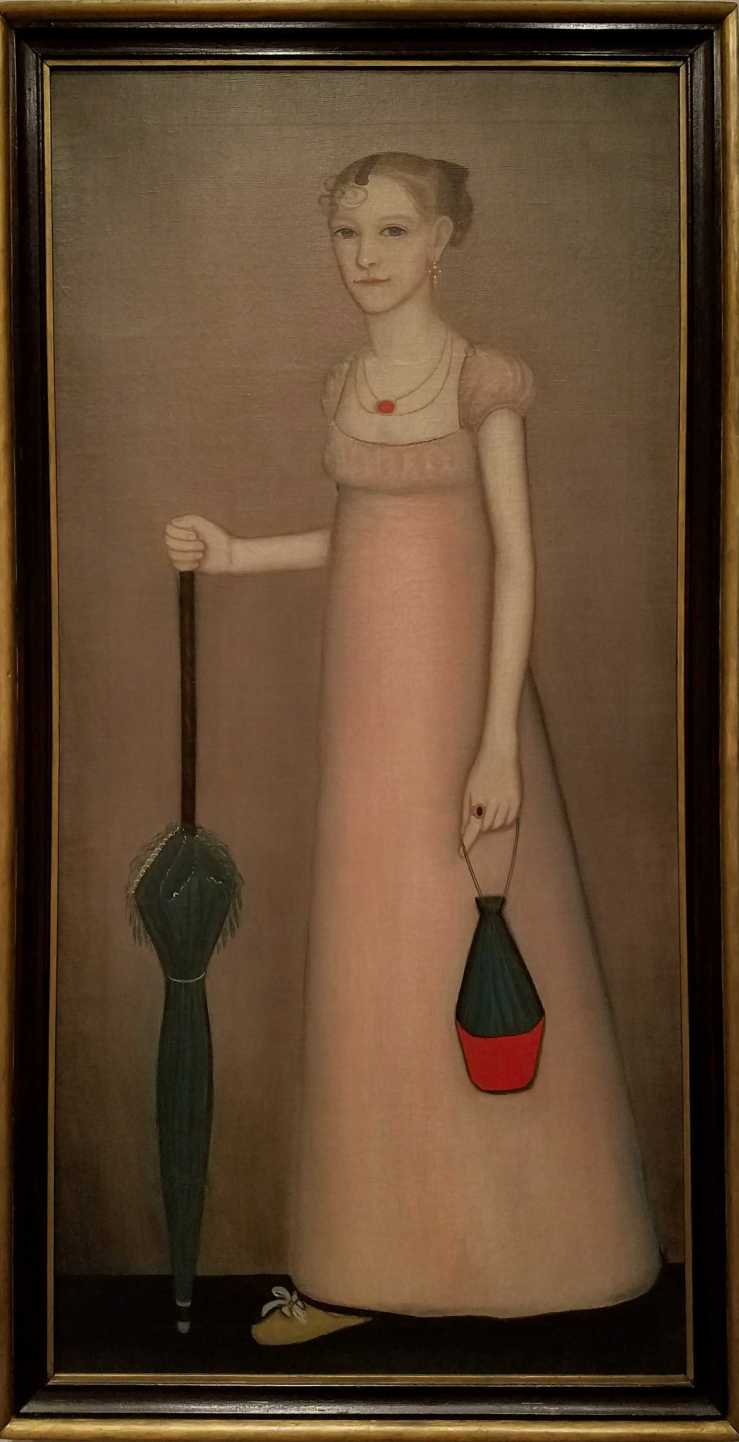
We leave the galleries with two ladies that, in my view, personify this intercultural dialogue; so far apart in time and style, yet so similar in their delicate, minimalistic technique; their differences and those red subtle details, only bringing them closer together.

Zhang Xiaogang (b. 1958)
Portrait, 1996
Oil on canvas

”Painted from a photograph, Zhang’s Portrait situates the subject in an eerie grey dreamscape. By imbuing the precision of photography with the modulated tones of a painting, Zhang imparts a surreal quality to the work. The portrait belongs to the artist’s Bloodline: Big Family series, based on family photographs taken before and during China’s Cultural Revolution. In the 1980s Zhang was part of a group of artists and philosophers opposing government repression and advocating for humanism, individual freedom and democracy. Despite its formal portrait conventions and the ubiquitous collared jacket, the painting represents an individual. Yet the notion of collectivity, central to the Cultural Revolution, still permeated Chinese society, as is evident in the repetition evoked by this series of paintings. The jagged red line, a reference to the bloodlines that tie a family together, cuts across the subject like a wound, imparting a subtle violence to the cool grey portrait.”


Ammi Phillips (1788-1865)
Harriet Leavens, ca. 1815
Oil on canvas

”Phillips was an itinerant, self-taught painter who spent much of his career travelling through small towns in the Berkshires and the Connecticut River Valley. An able marketer, he promoted his portraits in local newspapers as having been done ”in a correct style” with ”perfect shadows and elegant dresses in the prevailing fashion of the day.”
This portrait, among the most celebrated and widely recognized works in Phillips’ oeuvre, depicts the eldest daughter of the Leavens family of Lansingburgh, New York. She is portrayed as a slender, stylish young woman dressed in a gown in the Empire style, which as adopted from France.
With its simple geometries and pastel palette punctuated by flashes of blue, orange and red, the portrait looks forward to the modernist abstractions of the early twentieth century. Phillips’ work held particular appeal for American painters of that era.”


Harvard Art Museums, Boston

May 3rd, 2017

East meeting West in the Harvard Museums of Art

I already mentioned in the first part of this series, that the Harvard Art Museums collection spans centuries, styles and continents. Even a brief walk through the galleries proves this to be quite true. See, for example, how the display of objects from ancient Eastern civilizations is arranged so that they blend seamlessly with art from the 18th century.
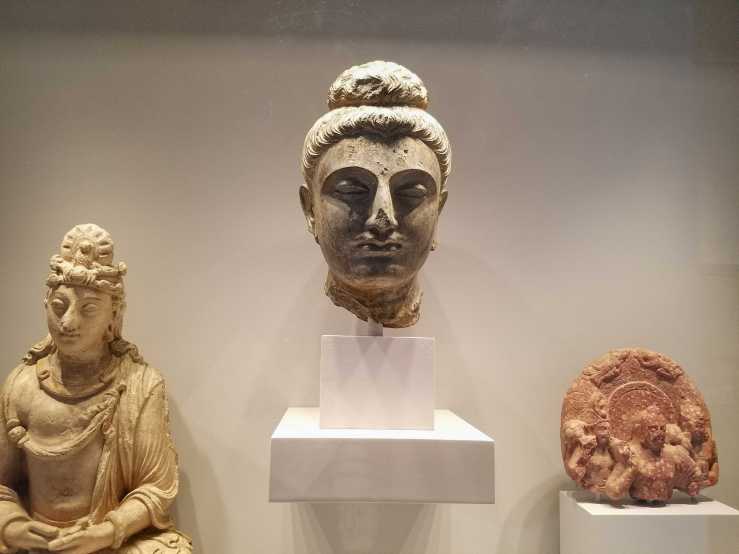
Head of a Buddha
Gandharan, Kushan period, 2nd century AD
From Pakistan. Dark grey schist

”With small mouth, slender nose, crisp, planar intersection of forehead and eyes and wavy locks of hair, this idealized image of a Buddha bears all the Classical features of Greek-inspired Gandharan sculptures.”
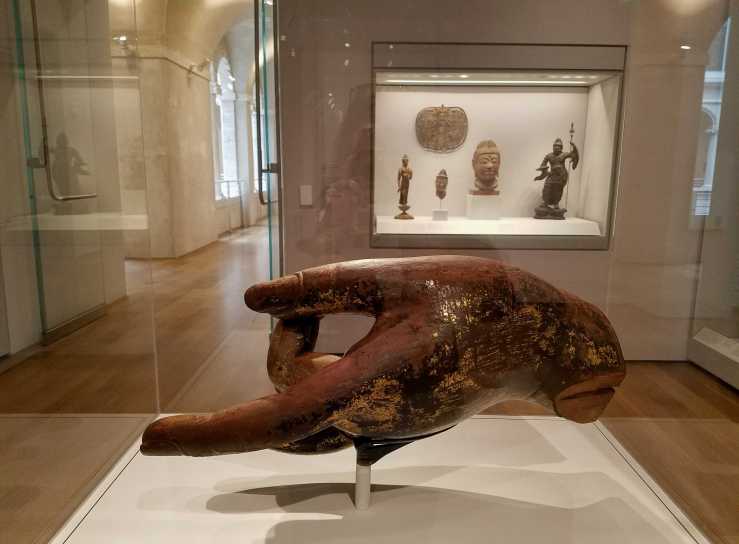

Attributed to Kaikei (active c. 1183-c. 1236)
Left Hand of a Colossal Amitābha Buddha (Amida)
Japanese, Kamakura period, late 12th-early 13th century
Wood, lacquer and gold

”The third and fourth fingers of this enormous left hand in the centre of the gallery, sculpted in a palm-up posture, would originally have curled upward to the thumb as part of a symbolic hand gesture, or mudra. Recent scholarly detective work has established that this hand belonged to a 16-foot standing Amida Buddha, installed at Shin-Daibutsu-ji Temple in Mie prefecture in central Japan. The sculpture’s right hand would have been held pendant, palm facing outward to complete the mudra, which is known in Japanese as the sakate raigō-in, or ”gesture of welcome to the soul of the deceased with upturned palm”.”
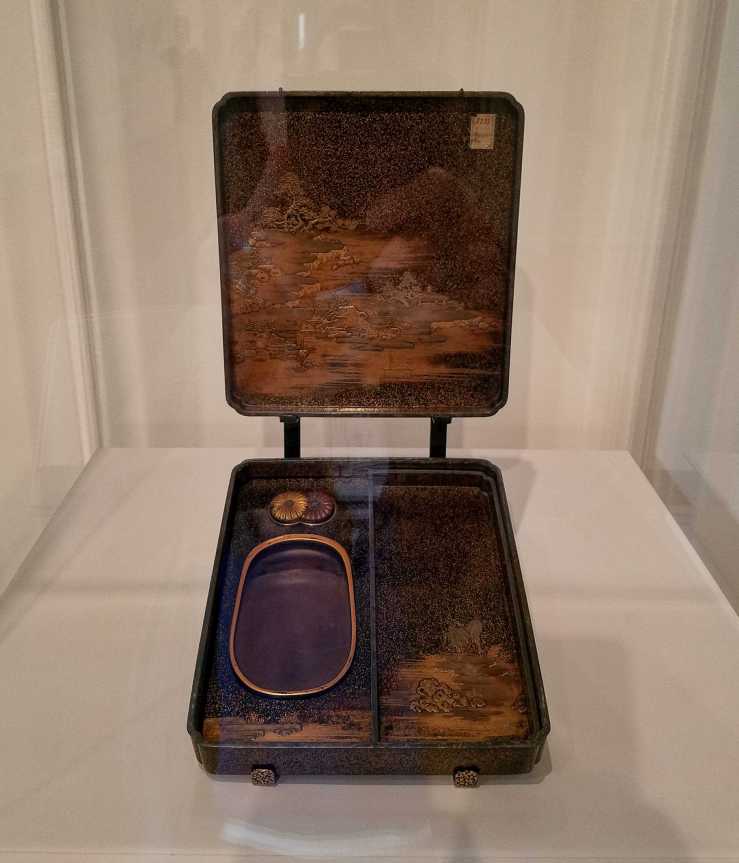

Inkstone Box (Suzuribako)
Japanese, Edo period, late 17th-early 18th century
Lacquer on wood with decoration in gold, silver and sabi urushi (thick lacquer paste) utilizing the hiramaki-e (low-relief sprinkled design), takamaki-e (high-relief sprinkled design) and nashiji (”pear-skinned” ground) techniques, with applied kirikane (cut gold and silver) and with sheet-lead inlays; stone and metal fittings
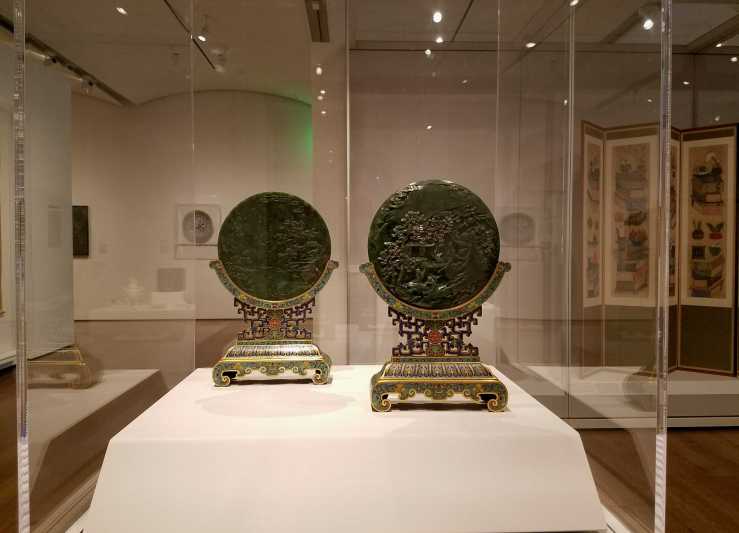

Pair of Jade Circular Table Screens
Mounted on Cloisonné Stands
Chinese, Quing dynasty, 19th century
Dark green nephrite (so-called spinach green jade); stands made of enamels on brass

”Table screens such as this pair were intended for decorative display within a scholar’s studio.  The flamboyancy of these ornate, deeply carved screens and cloisonné stands suggests that they were likely made for a scholar’s studio within a palace, as the environs of a typical Confucian scholar’s studio would have been more restrained.”
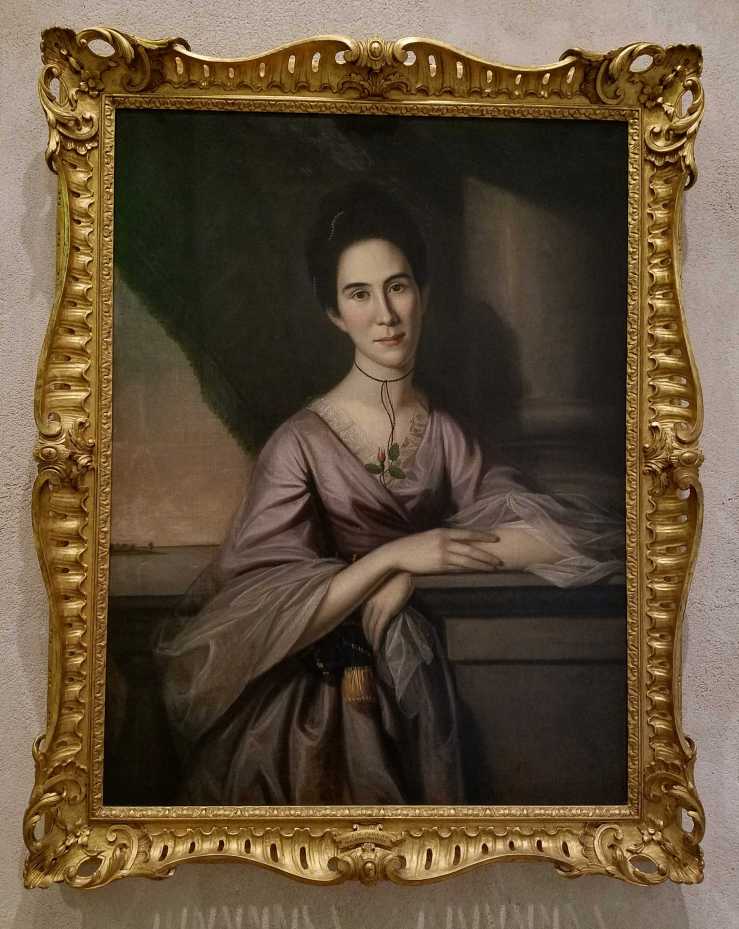

Charles Willson Peale (1741-1827)
Susanna Steuart Tilghman (Mrs. James Tilghman), 1775
Oil on canvas

”Charles Willson Peale, who founded one of the first museums in America, began his career as a portraitist. He spent his early years in Annapolis and during the Revolutionary period enjoyed the patronage of prominent landed families in the area. Susanna Steuart Tilghman and her husband, James, helped fund Peale’s travel to London where he studied with the expatriate American painter Benjamin West. Emulating the grand patrons of Europe, the Tilghmans and their peers helped launch Peale’s distinguished career, which would include commissions from important dignitaries and would culminate in the founding of the Philadelphia Museum. Housing natural history specimens and portraits of Revolutionary heroes, the museum opened in the city’s Independence Hall in 1786.”
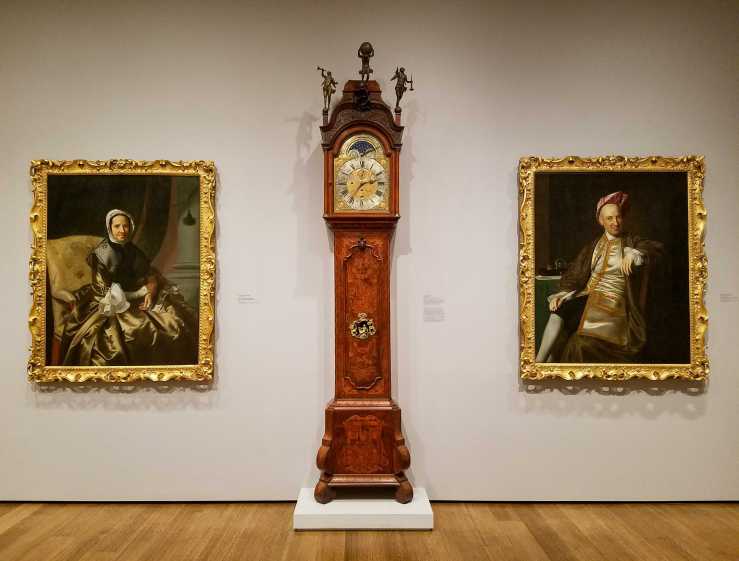

Otto van Meurs (1714-1783)
Case, mounts and face by unidentified artists
Long Case Musical Clock, ca. 1750-75
Oak with burl walnut veneer, mahogany inlay (possibly with later additions), walnut moldings and a gilt brass mount; silvered, gilt and pained brass dial

”Crafted by one of the leading clockmakers in 18th-century Amsterdam, this clock displays important information but is also a richly symbolic object. Its elaborately ornamented dial keeps time and indicates the day of the week, the month, the phase of the moon, the lunar date and the tides. The case, inlaid with woods imported from around the world, is adorned with a gilt brass mount showing Father Time holding an hourglass. Finials representing Atlas and a pair of trumpeting angels rise at the top of the pediment.
The true marvel of this clock is its music. To mark the hour, a set of ten carillon bells powered by an internal gear train sounds on of eight popular tunes.”

Paintings on the left & right side of the clock are by John Singleton Copley (1738-1815)
Left: Sarah Morecock Boylston (Mrs. Thomas Boylston), 1766 – Oil on canvas
Right: Thomas Boylston II, ca. 1767-69 – Oil on canvas
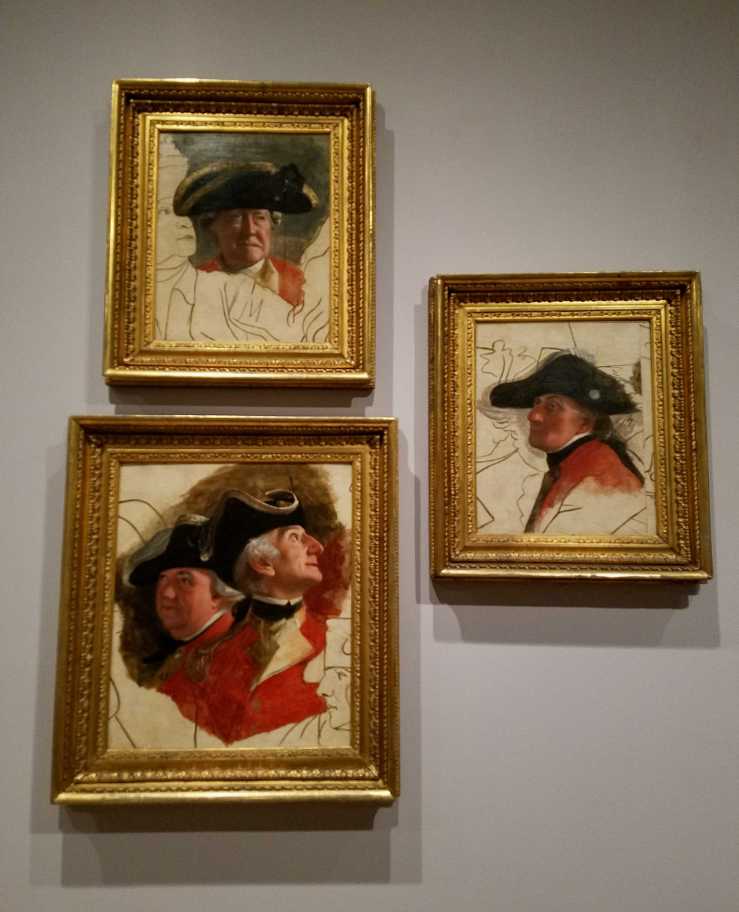

John Singleton Copley (1738-1815)
Major General August de la Motte, 1787
Oil on canvas

Colonel Ernst August von Hugo and Lieutenant Colonel von Schlepegrell, 1787
Oil on canvas

Colonel Gustav Friedrich von Dachenhausen, 1787
Oil on canvas

”In 1783, the City of London commissioned Copley to create a large public painting commemorating Britain’s victory over the French and Spanish navies at the Siege of Gibraltar in 1782. These portraits were preparatory studies for that painting.”
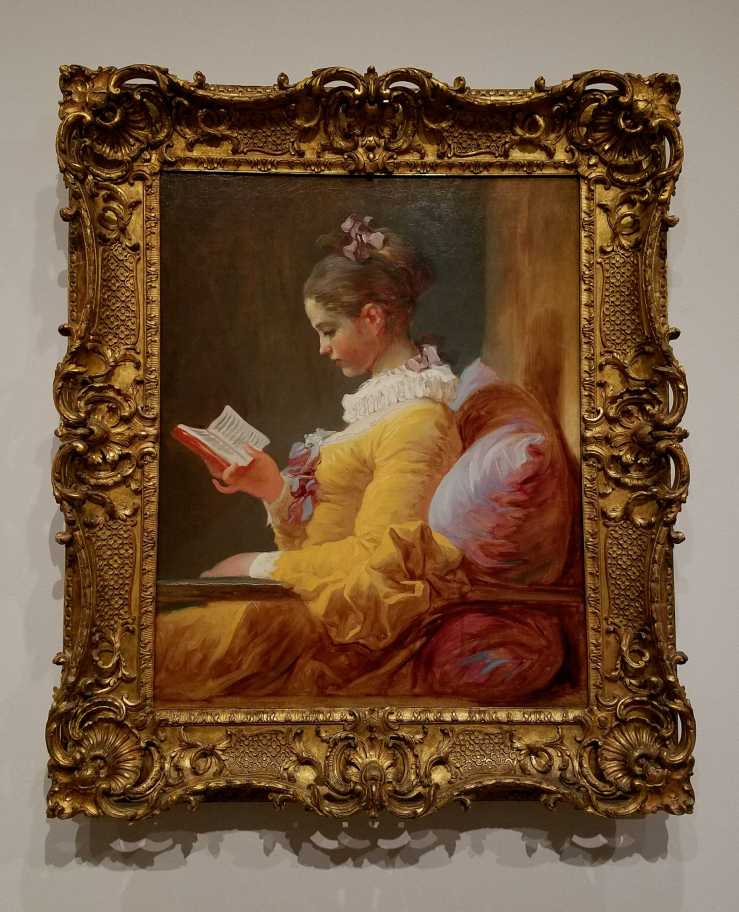

Jean-Honoré Fragonard (1732-1806)
Young Girl Reading, ca. 1770
Oil on canvas

On loan to the Harvard Art Museums from the National Gallery of Art in Washington.


Harvard Museums of Art, Boston

May 3rd, 2017