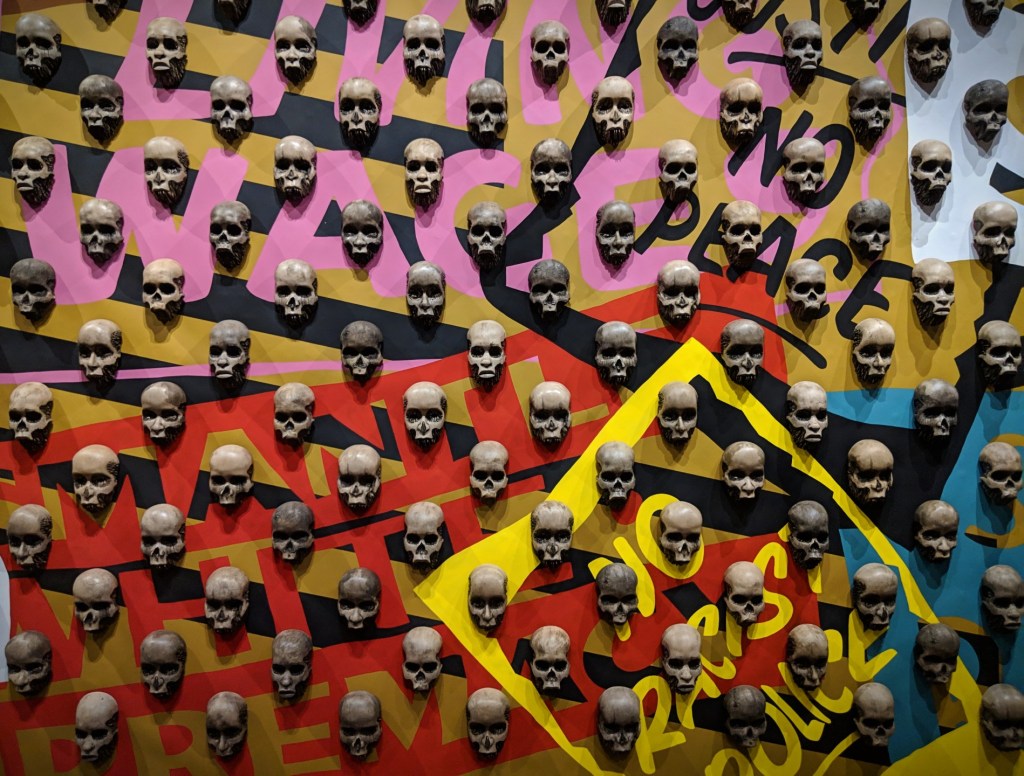
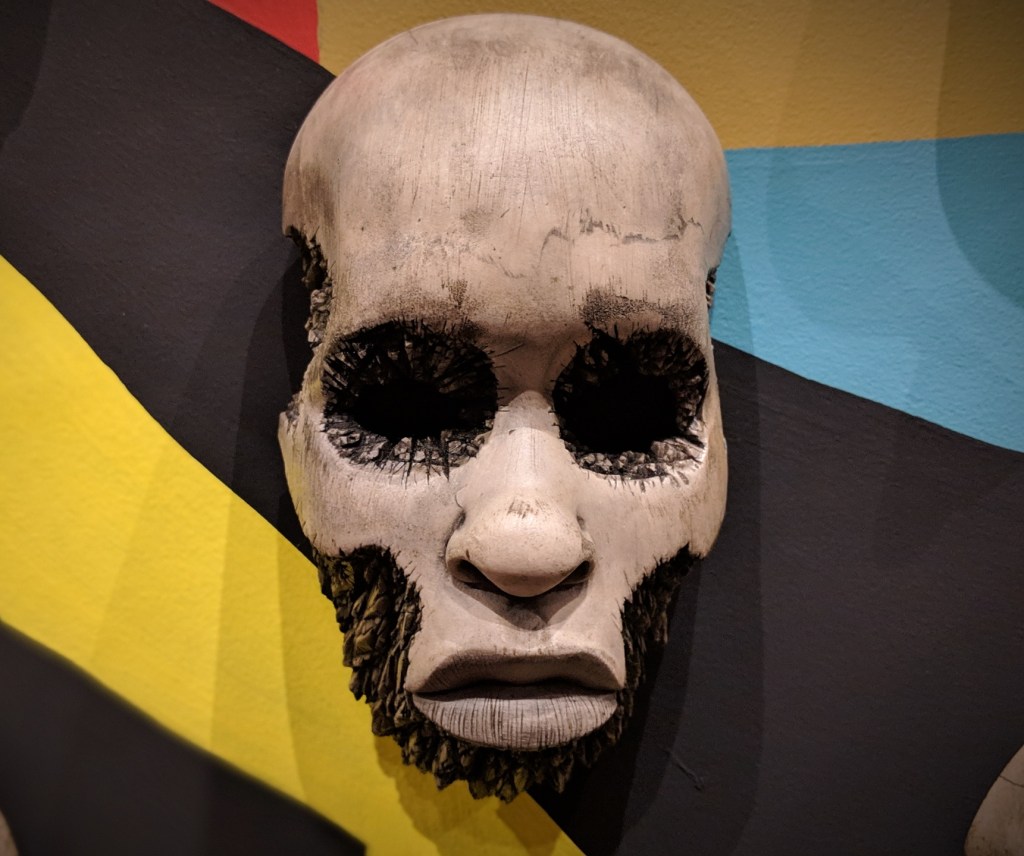
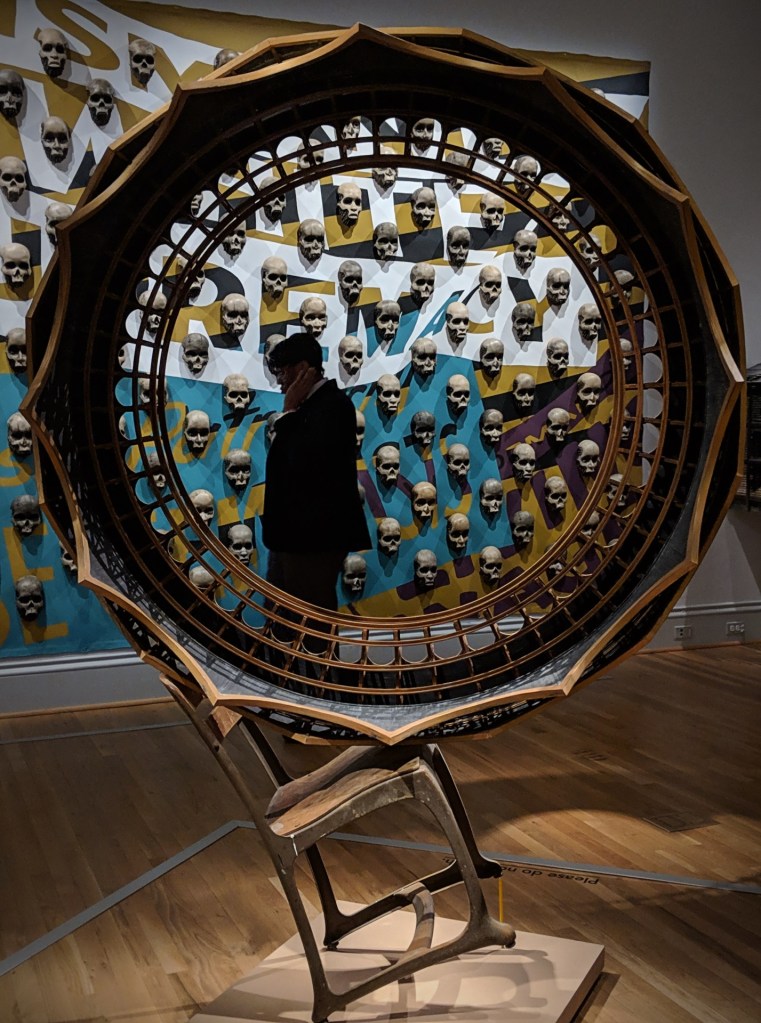
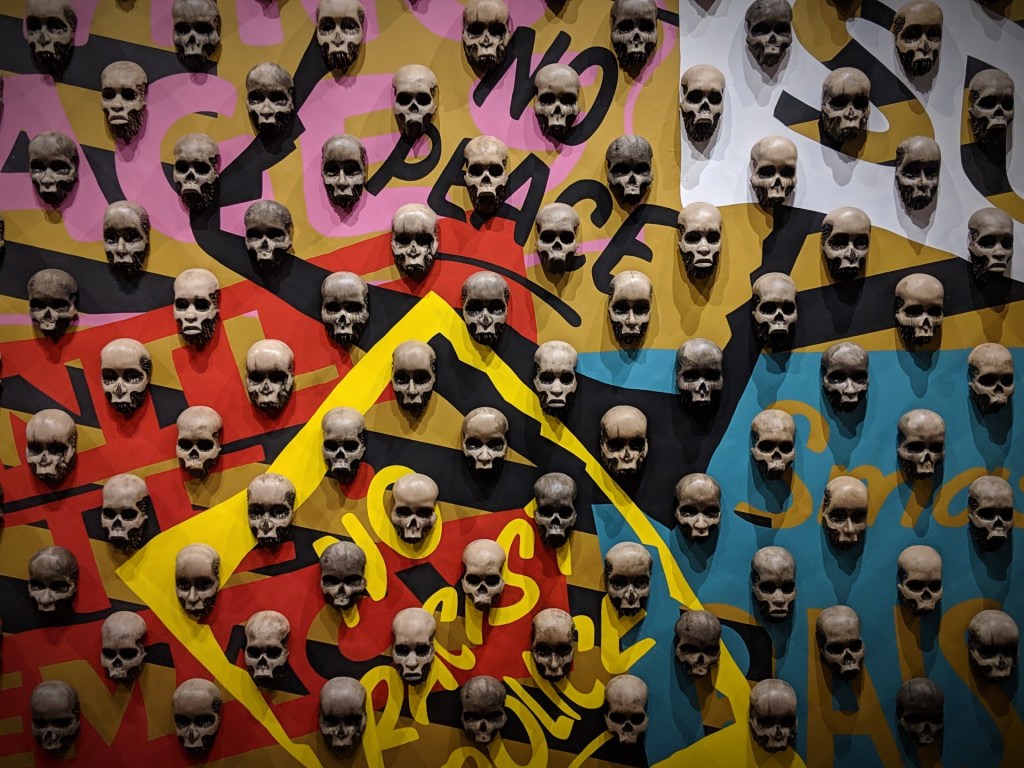
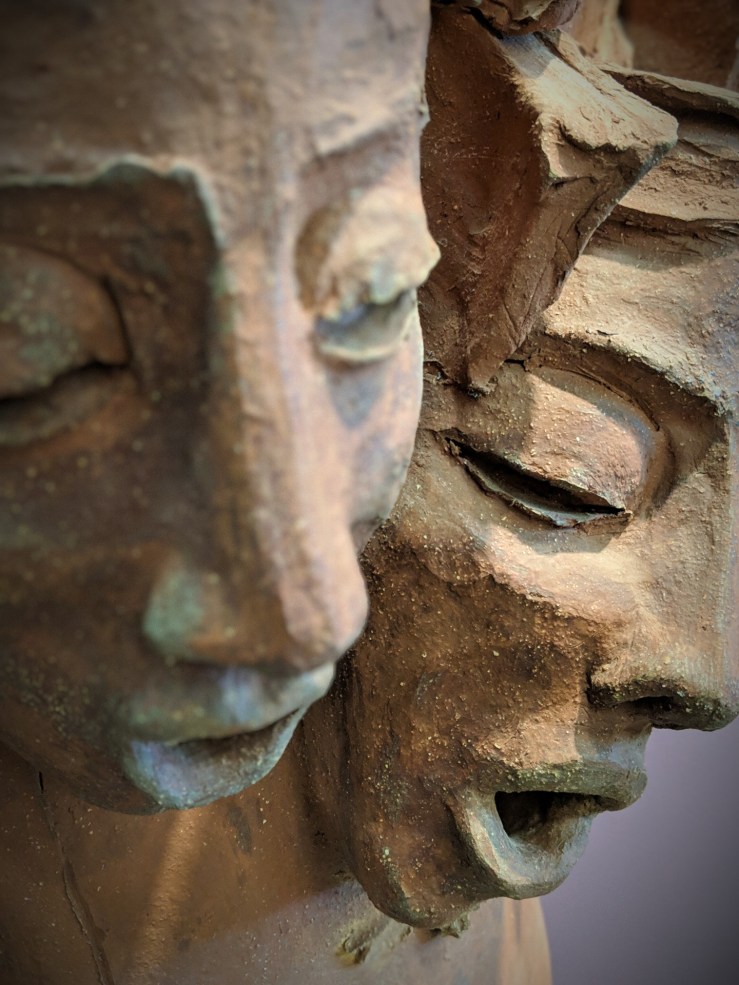
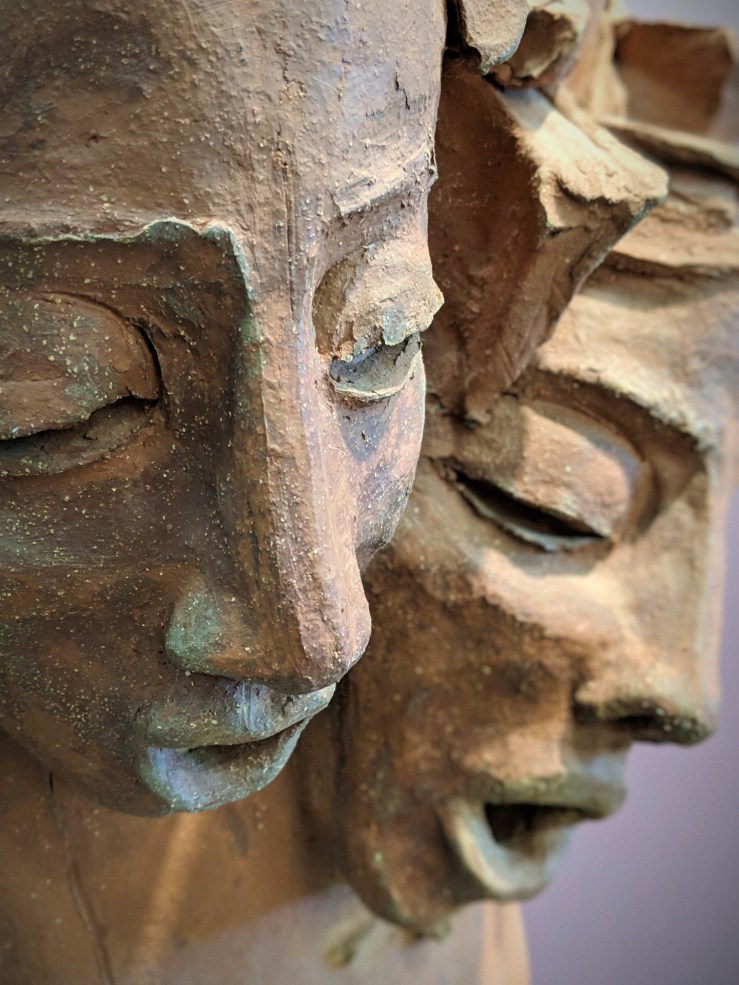
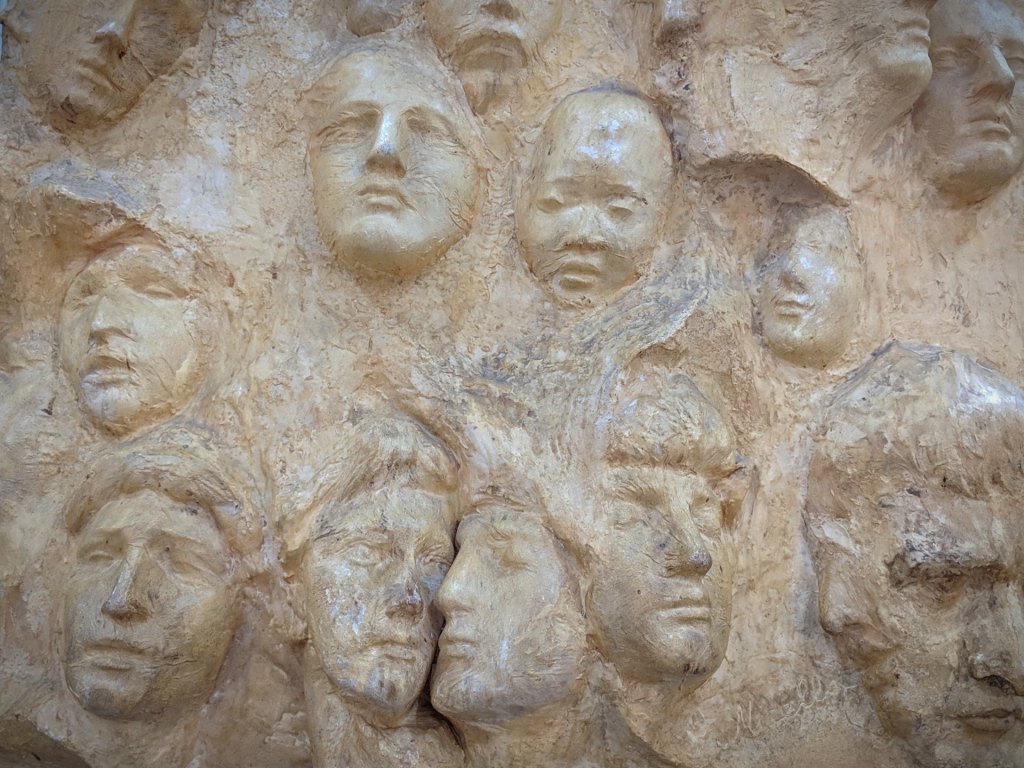
Dustin Farnsworth X Timothy Maddox : Wake II 2017, Aqua-Resin, Hydro-Stone, various polychrome, canvas, and vinyl acrylic paint
Created as a response to the tragic amount of school shootings in the United States and the Boko Haram abductions of Nigerian schoolgirls in 2014, these skull-like masks represent children’s faces.
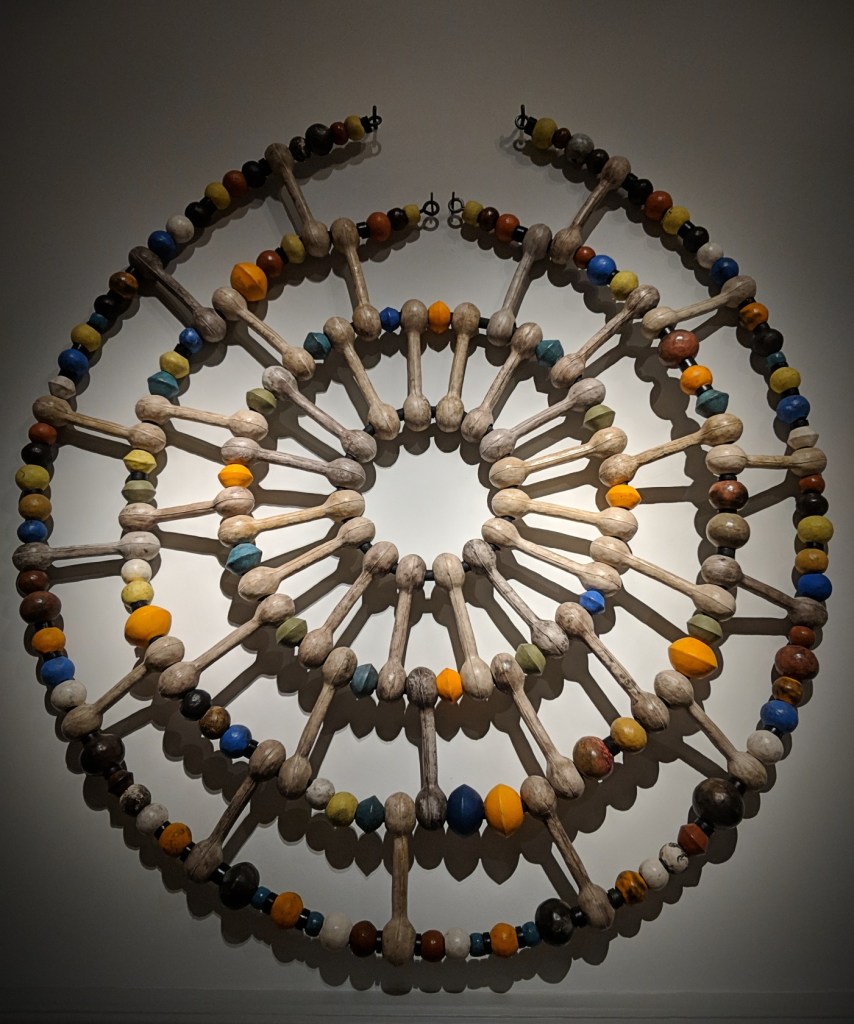
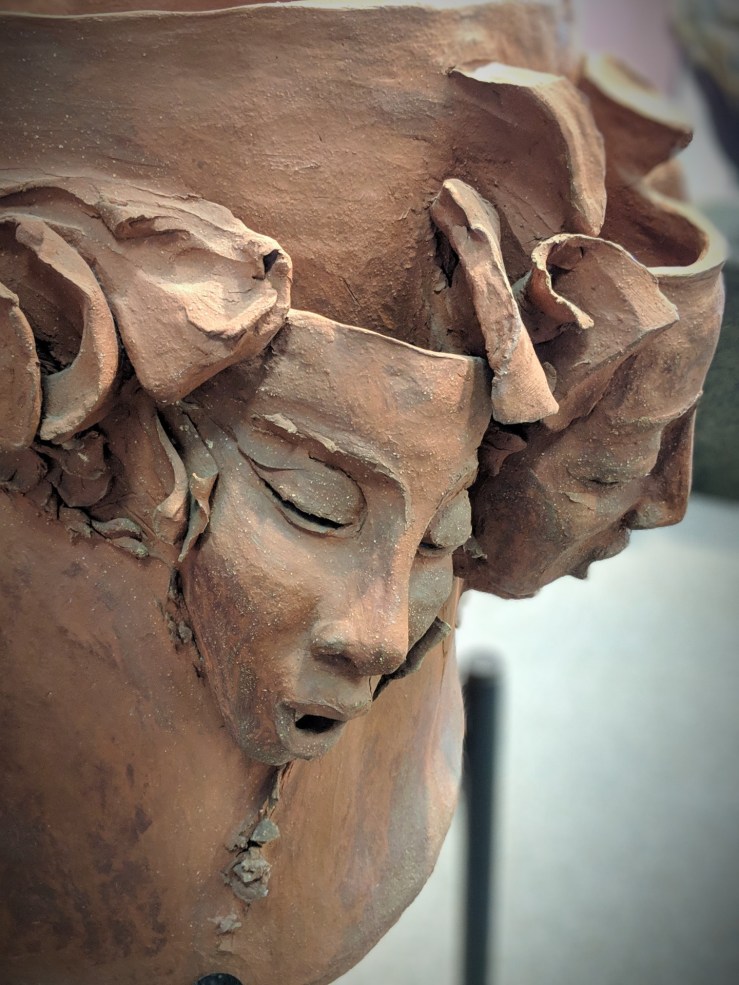
Sharif Bey – Louie Bones-Omega, 2017, earthenware, vitreous china and mixed media
Choker with Nineteen Death Heads. Mexico, Mixtec, AD 1200-1500 Library of Congress
This choker’s beads consists of nineteen nearly identical skulls carved from conch shells. The deeply carved eye sockets may have originally held hematite inlays. Young nobles who were being schooled in religion and military arts wore such necklaces throughout the Central Mexican Highlands.
Images from ”Disrupting Craft: Renwick Invitational 2018” presenting work from four artists: Tanya Aguiñiga, Sharif Bey, Dustin Farnsworth and Stepanie Syjuco, paired with a choker with Nineteen Death Heads, from Mexico from the Library of Congress.
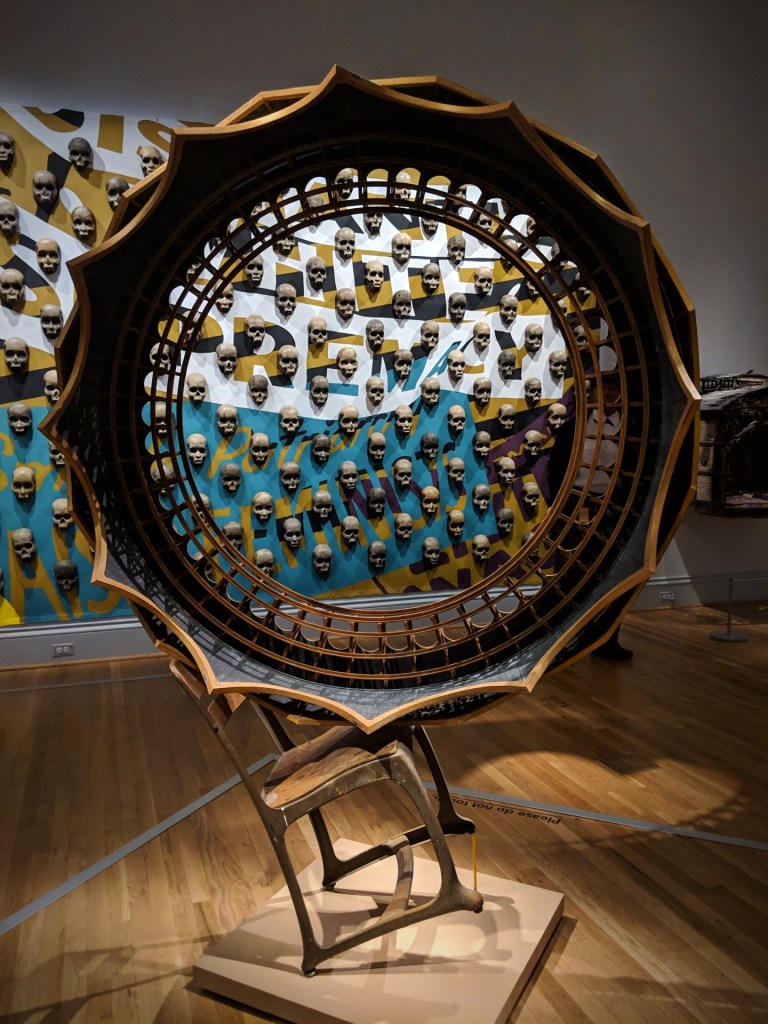
Palapa, 2017 by Tanya Aguiñiga Powder-coated steel and synthetic hair
Named for the open-sided thatched huts that pepper the beaches of Mexico. These distinctive shelters are woven by Mexicans but used mostly by tourists. Aguiñiga’s mysterious, surreal interpretation of these everyday structures is symbolic of her own ambiguous identity, as someone who navigates the dual worlds of palapa maker and user, of and outside both cultures.
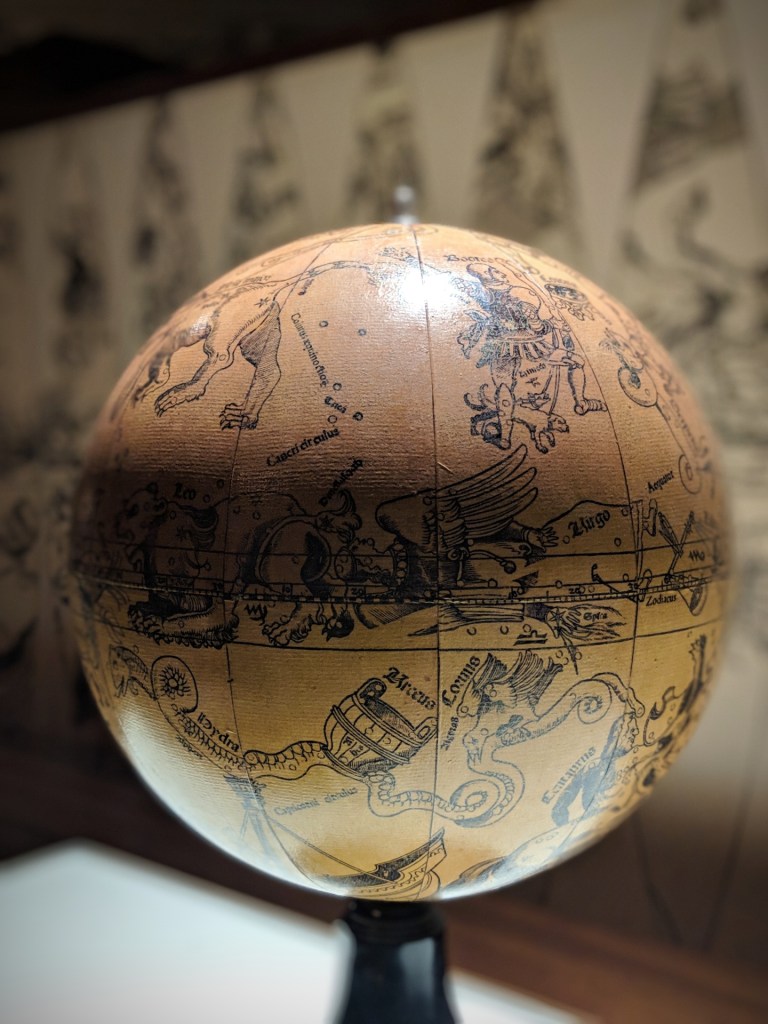
Schoener’s Celestial Globe: Among Schoener’s globe gores included in the Sammelband is the first-known set of printed celestial gores that he designed in 1517. These gores annotated by Schoener represent the state of astronomical knowledge in his time and are in improvement over many of the star charts of the period.
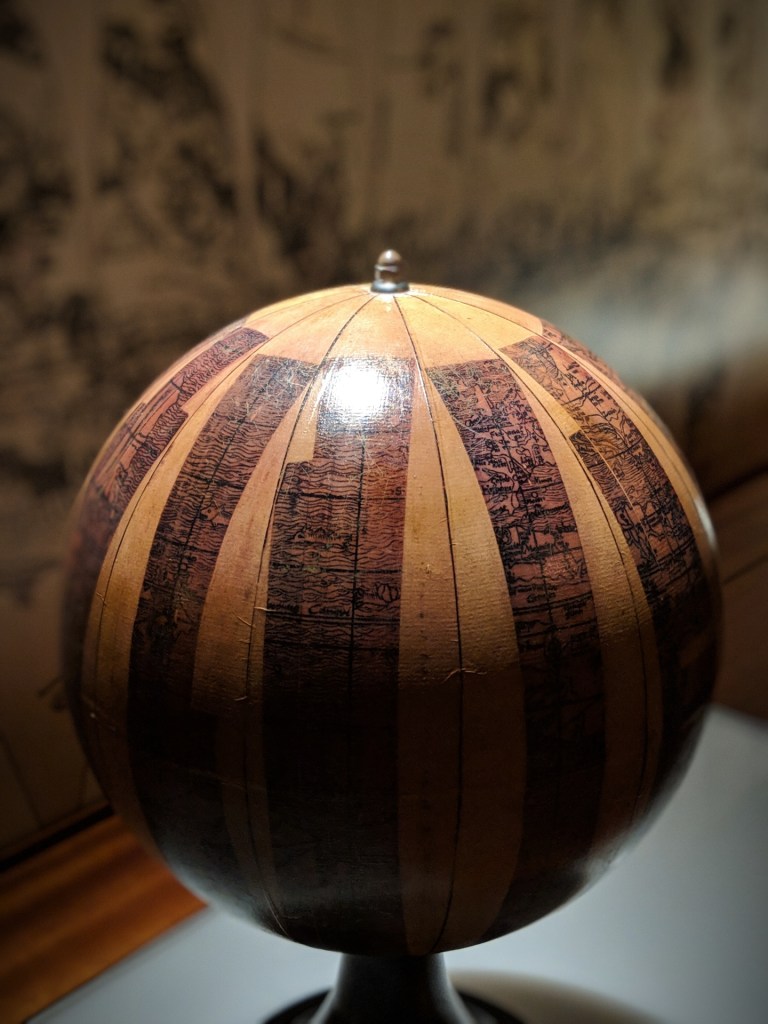
Globe from Schoener Terrestrial Gore Fragments: This globe is recreated from fragments of globe gores that were found in the binding of the Sammelband when it was taken apart in 1903. The fragments are printed on vellum and are the only surviving examples of terrestrial globe gores for the 1515 globe made by Johann Schoener. Schoener used Waldseemueller’s 1507 Universalis cosmographiae as one of his primary geographic sources for the information found on this globe.
The Reconstruction Of Saints, 2018 by Dustin Farnsworth Aquaresin, fiberglass, foam, plywood, 24k gold
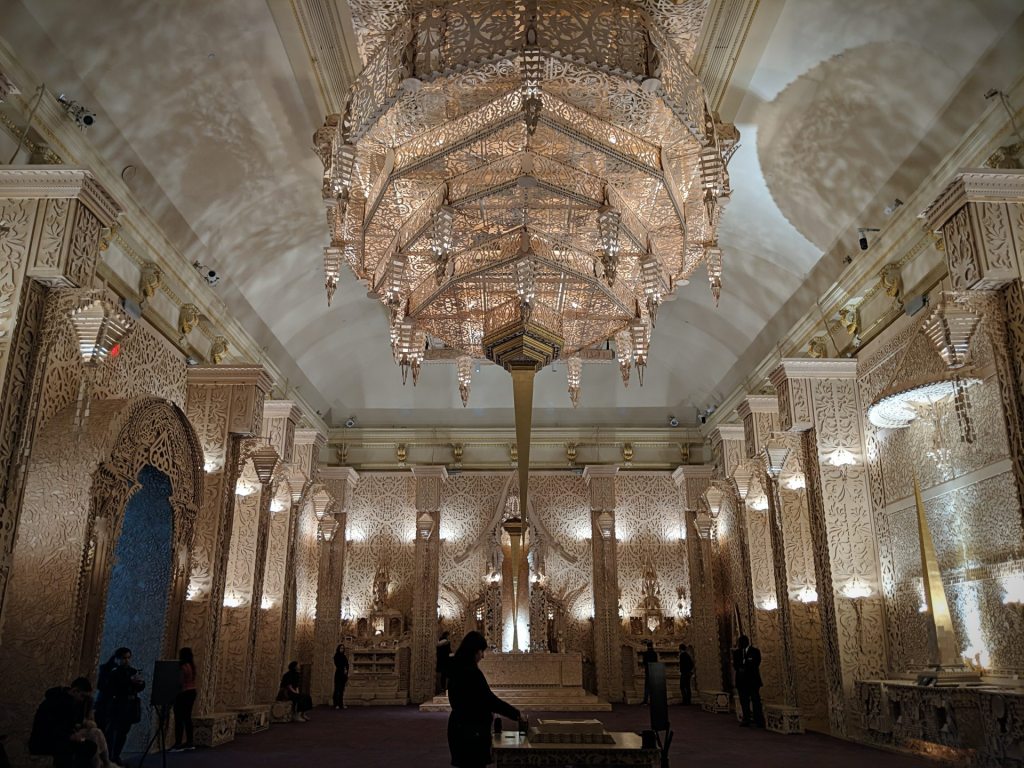
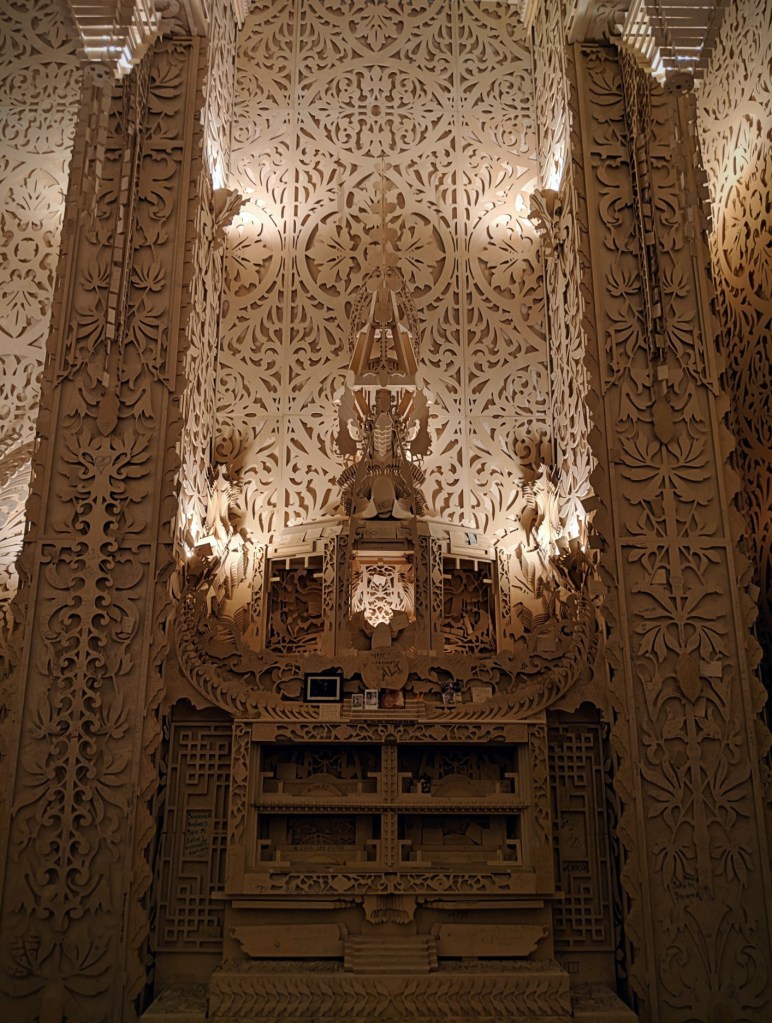
Since 2000, David Best has designed and coordinated the construction of approximately half of the Burning Man temples. Established as sacred spaces of reflection and prayer, all of these have been massive, incredibly intricate, wooden structures. During the week of Burning Man, the Temples are adorned by participants with memorials and inscriptions. The structure is burned in a cathartic ritual to inspire healing and community. Since 2005, Best has also built similarly ephemeral temples in public spaces outside of Burning Man, within the United States and in countries such as Ireland and Nepal. Committed to the values of inclusion and participation, he creates opportunities for anyone who wants to take part in his projects, augmenting a core group of volunteers known as the Temple Crew with members of each community where he works.
Originally part of the exhibition No Spectators: The Art of Burning Man, this site-specific installation covered the walls with intricately carved raw wood panels that lead to an ornate altar. Wooden placards were provided for visitors to write a personal message and leave within the installation [on show from March 2018 to January 2020].
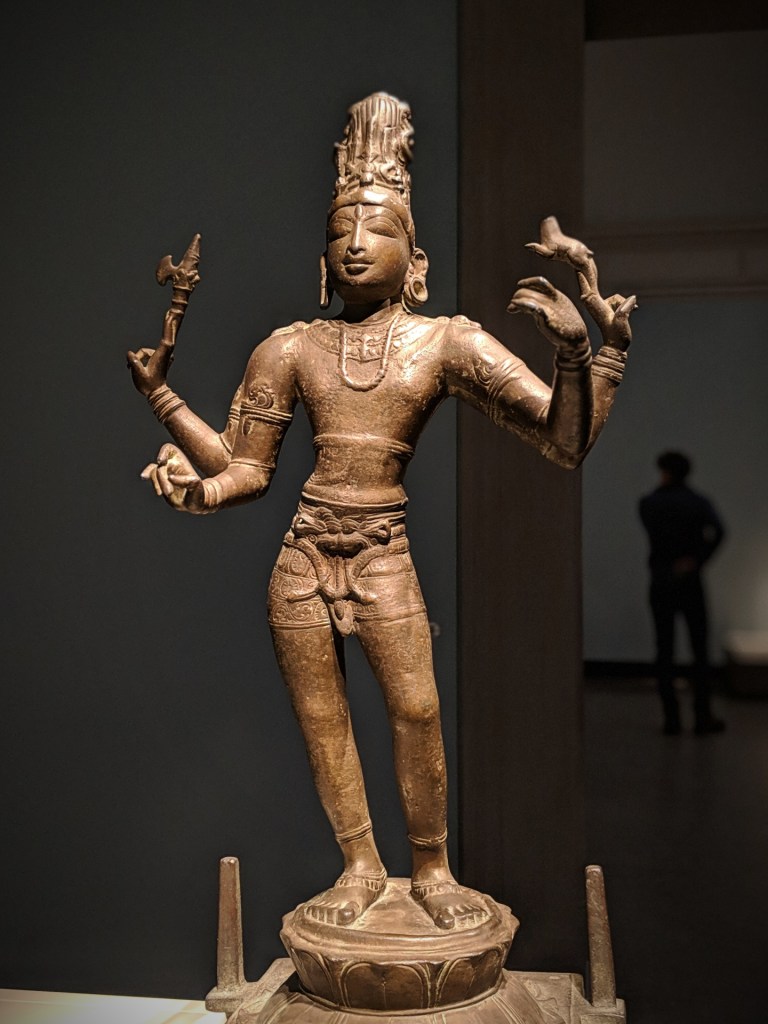
Bronzes provide a body through which gods make themselves available and accessible to humans. Inspired by the verses of south Indian poet-saints, sculptors sought to endow each bronze deity with breathtaking presence.
The poet Sambandar expressed the impact of encountering Shiva embodied as Lute Player, one of the god’s many forms:
The coral red Lord came to me chanting sweet Tamil poems. He stayed, playing the lute, singing songs to the beat of the mulavam and montai drums. Now he is gone. Taking my beauty with him, Leaving me pale as the kumil flower.
Shiva, Player of the Lute (Vinadhara) India, state of Tamil Nadu, Chola dynasty, ca. 950 – Bronze
Shiva, Lord of Dance (Nataraja) India, state of Tamil Nadu, Chola dynasty, ca. 990 – Bronze
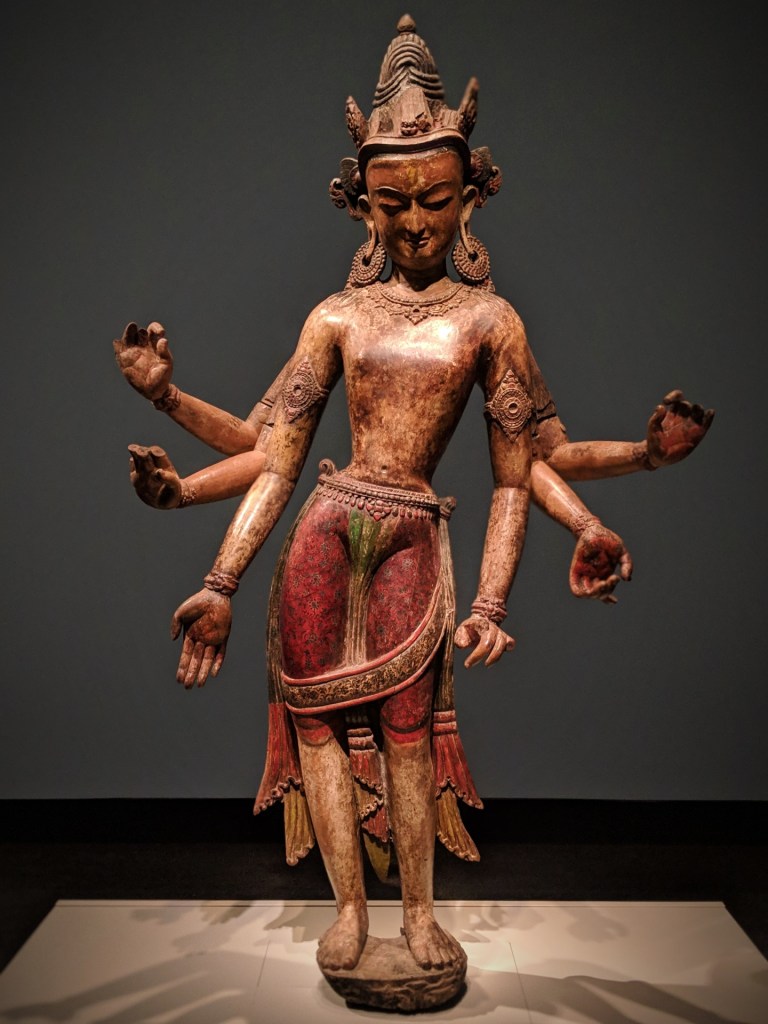
White Avalokiteshvara (The Lord Who Looks down from Above) Nepal, early Malla dynasty, 14th century – Polychromed wood
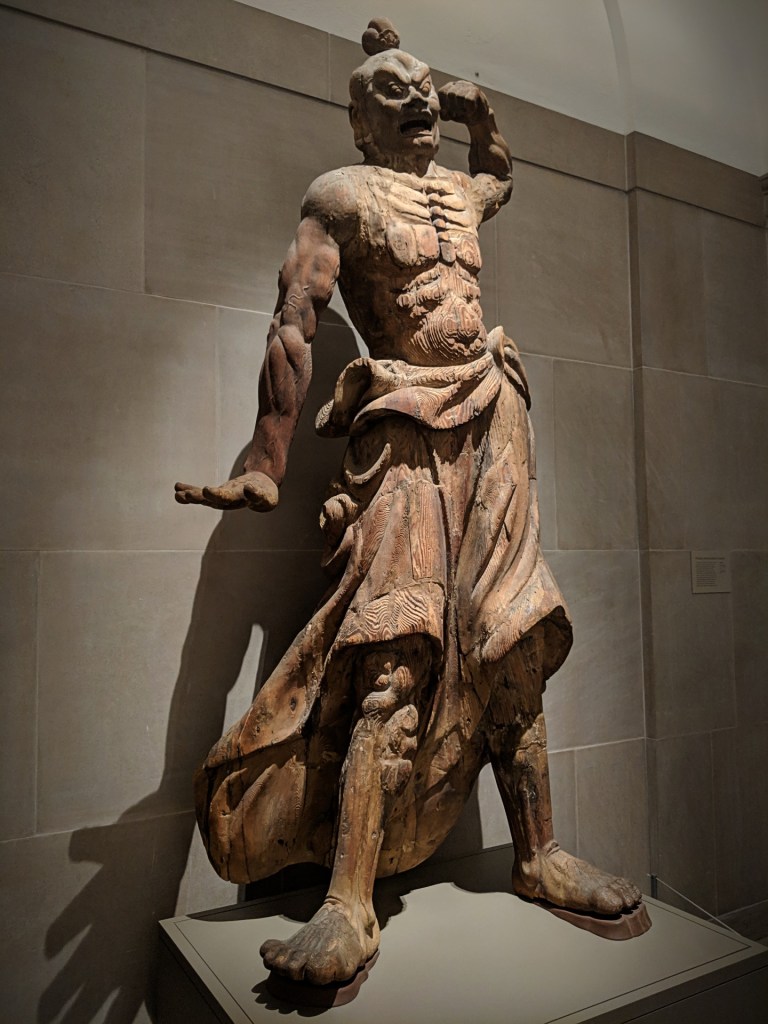
This mighthy protector of the Buddha once stood guard at the entrance to Ebaradera, a temple in Osaka, Japan.
Guardian Japan, Kamakura period, 1185-1333 – Wood
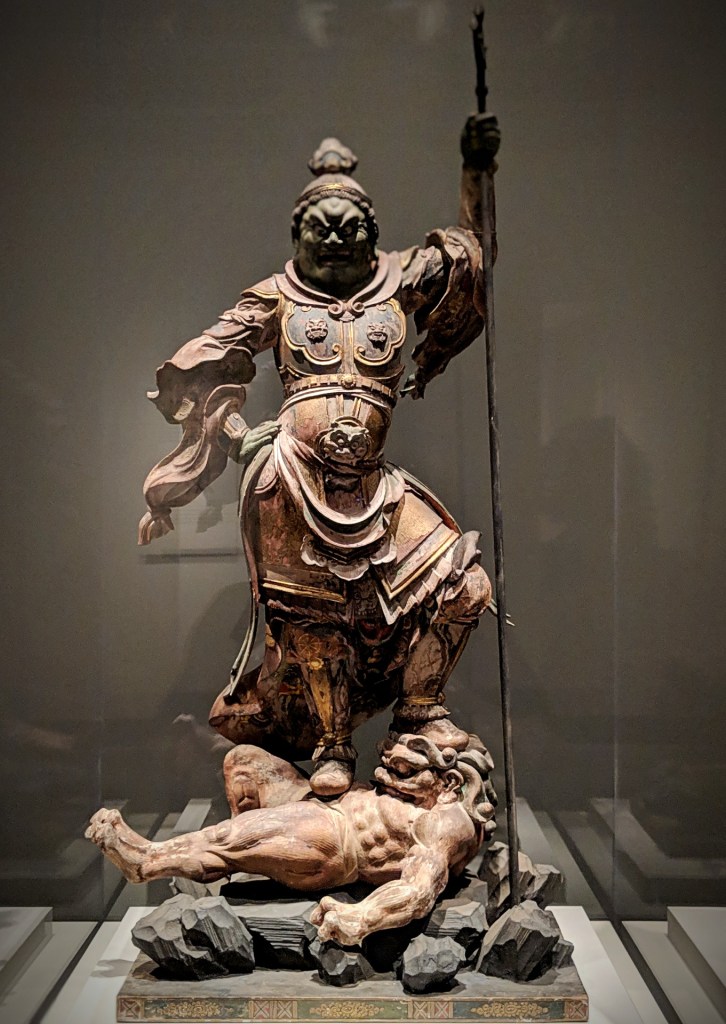
Komoku-ten, Guardian of the West Japan, Kamakura period (1185-1333), Wood with polychrome, gold, and crystal
Lord of Burning Desire Aizen Myoo, whose name means ”king of bright wisdom dyed in love”, is the avatar of sacred lust in esoteric Buddhism. Here, his red body, six arms, glaring eyes, snarling face, symbolic weaponry, and bared-tooth lion headdress create a threatening image. Yet he is seated on a throne shaped like a lotus, an auspicious Buddhist symbol, to remind believers of his benevolence.
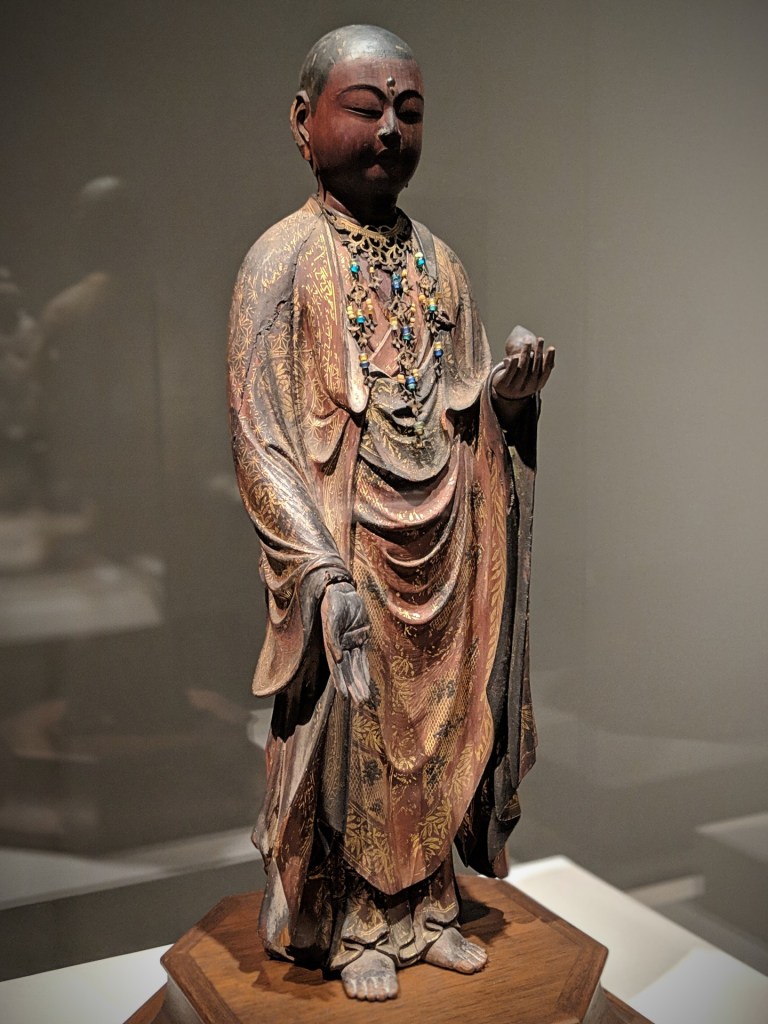
The Bodhisattva Kshitigarbha (Jizo) Attributed to Kaikei (act. late 12th – early 13th century) Japan, Kamakura period, 1185-1333 – Wood with applied gold
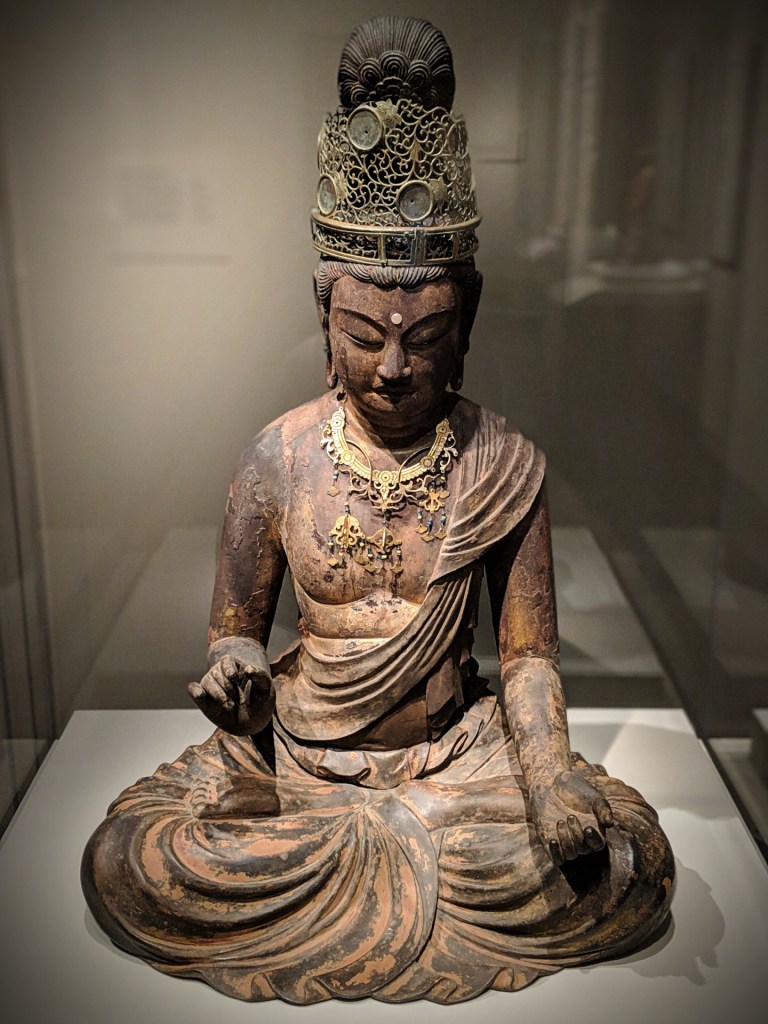
Bodhisattva Kaikei (act. ca. 1185-1220) Japan, Kamakura period, early 13th century – Wood with lacquer, gold, copper, and crystal
Incense burner Probably Syria, Mamluk period, mid-15th century – Brass inlaid with silver
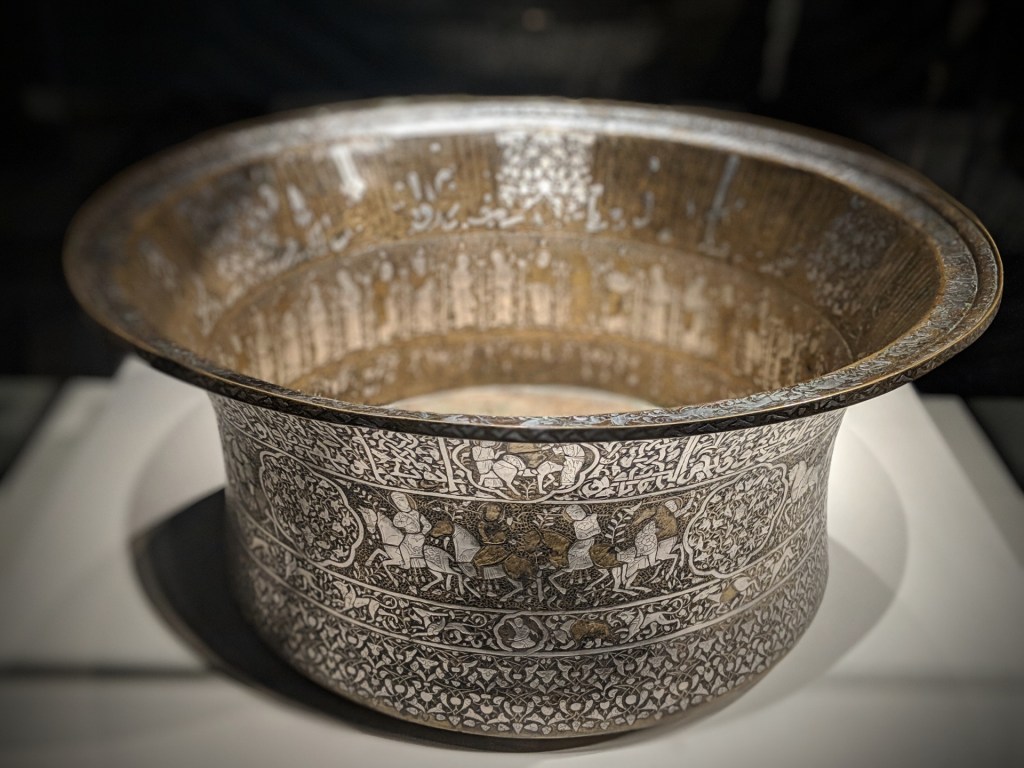
Basin Syria, ca. 1240 – Brass inlaid with silver
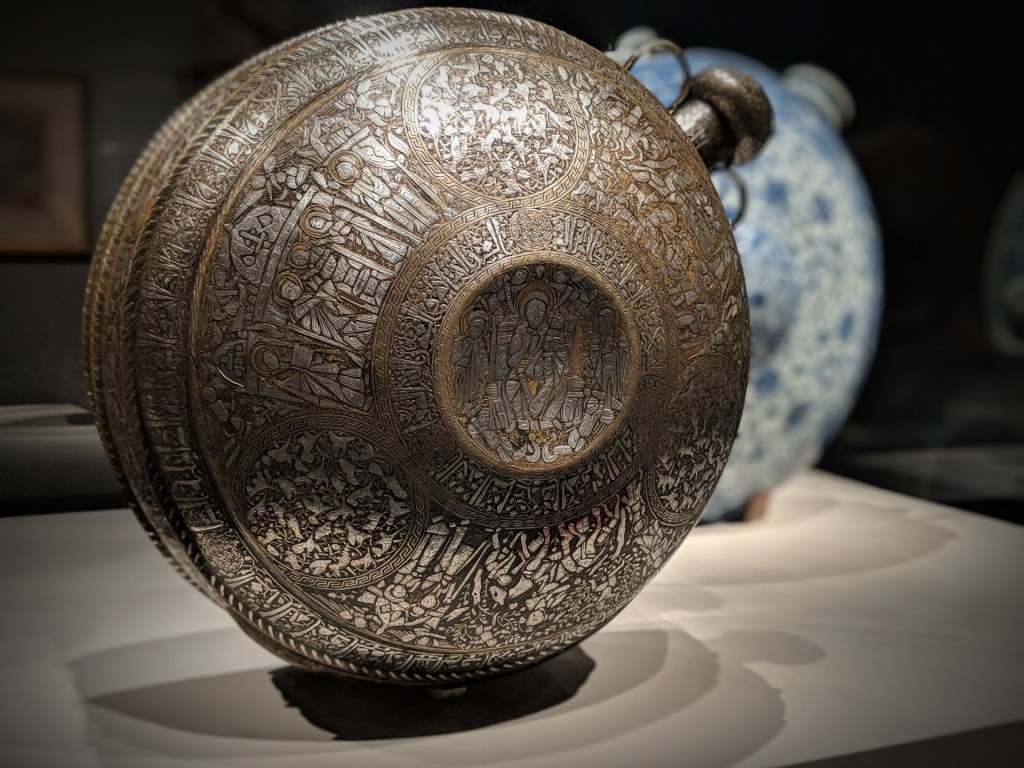
Canteen Iraq, Mosul, ca. 1240s – Brass inlaid with silver
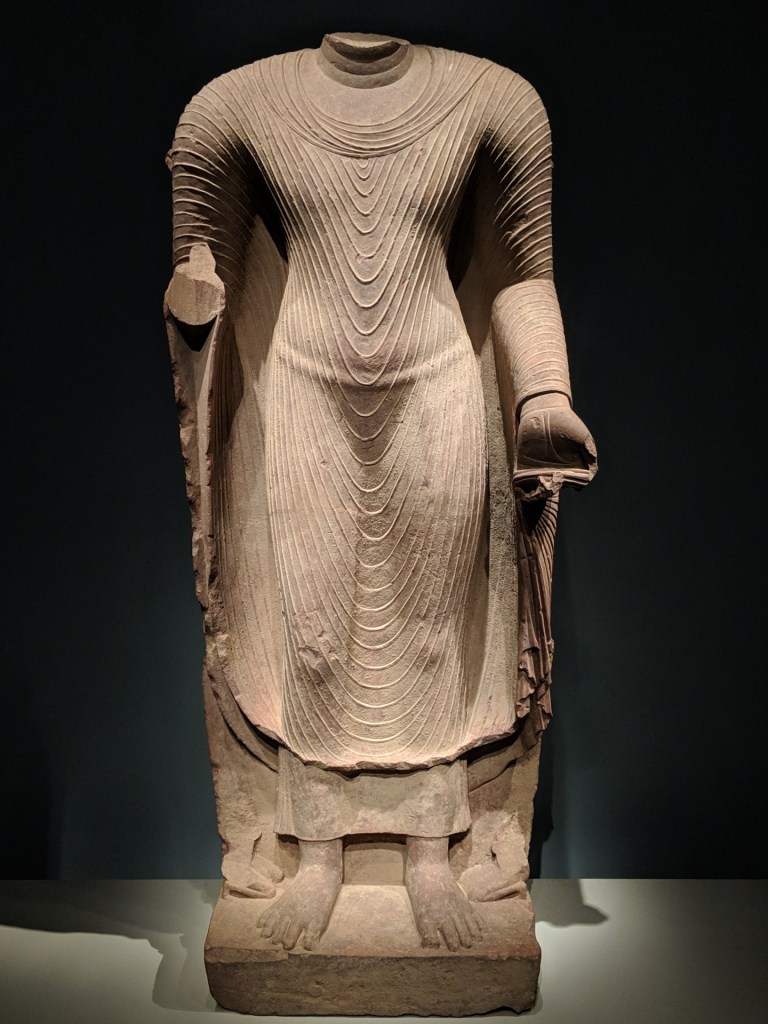
Standing Buddha India, state of Uttar Pradesh, Mathura, ca. 320-485 – Sandstone
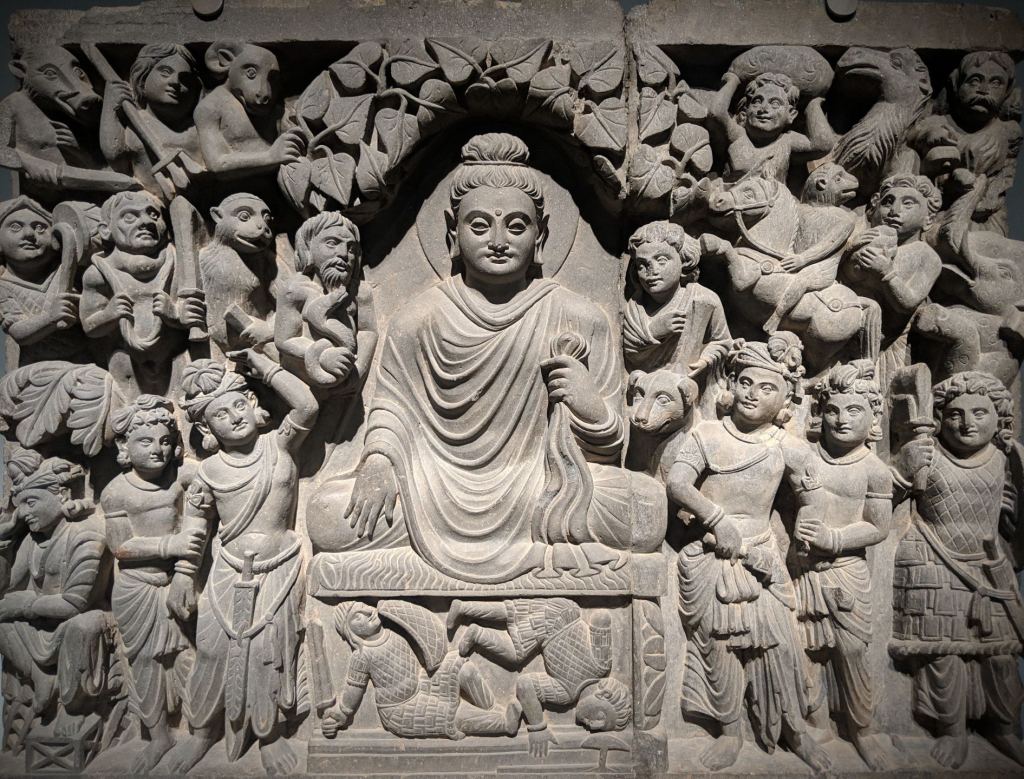
The Enlightenment of the Buddha After many years of mortifying his body through fasting, the Buddha ate some rice porridge and vowed to attain enlightenment through physical moderation and meditation. When the Buddha approached the moment of spiritual awakening, the god of desire and death, Mara, began to fear that he’d lose control over humankind. Here, Mara’s demon army tries to distract the meditating sage. Selfishly attached to worldly power, the demons have distorted features, excessive gestures, or half-animal bodies. In contrast, the Buddha – symmetrical, central, still – serenely meditates. His right hand, lowered in the earth-touching gesture, signals imminent victory over death and desire.
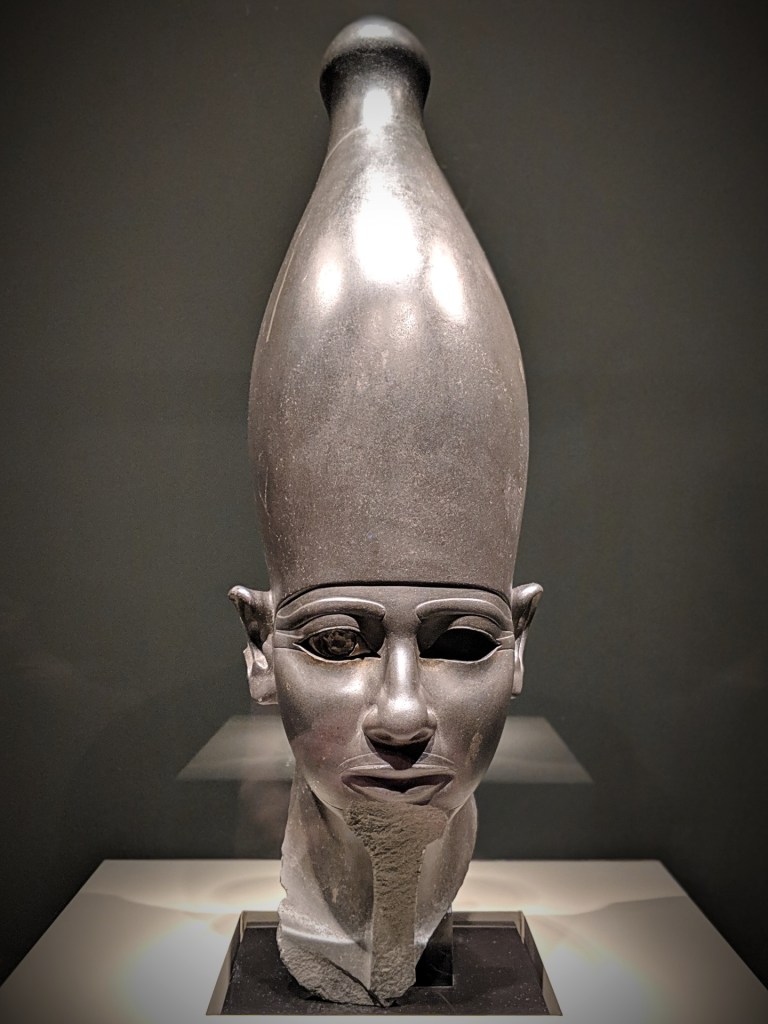
Pharaoh head Egypt, Dynasty 5 or 6, Old Kingdom, ca. 2675-2130 BCE
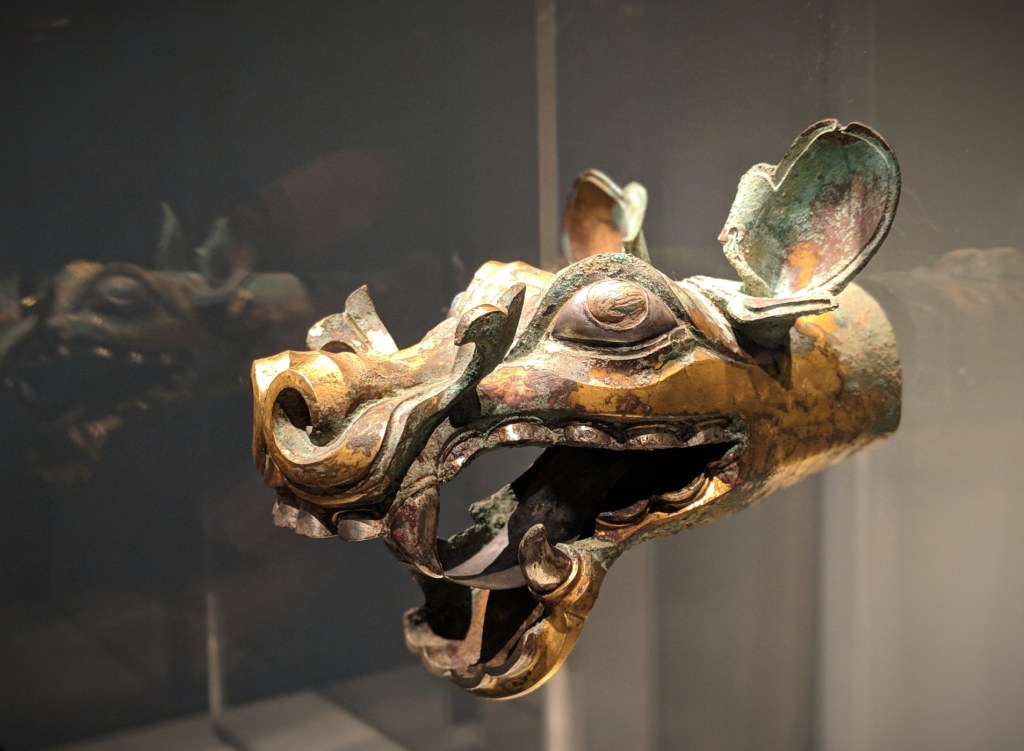
Chariot shaft ornament in the form of a dragon head Late Eastern Zhou dynasty, ca. 400-300 BCE
Bi China, late Neolithic period, Liangzhu culture, ca. 3300-2250 BCE – Jade Thousands of jade bi (pronounced bee) have been unearthed in elite Liangzhu culture burial sites, yet their meaning, purpose and ritual significance remain unknown.
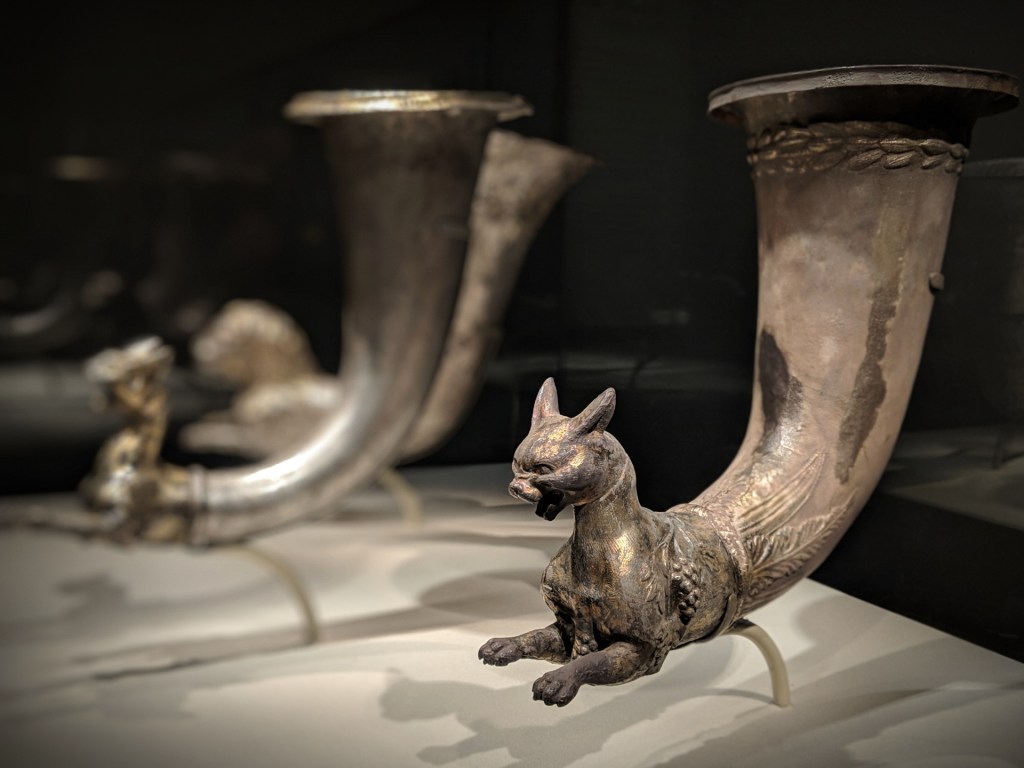
Wine horns are among the most remarkable Parthian ceremonial objects. Called rhyta in the Greek world, they were originally known in Persian as palogh and later as shakh (horn) or shakh-i bade (wine horn).
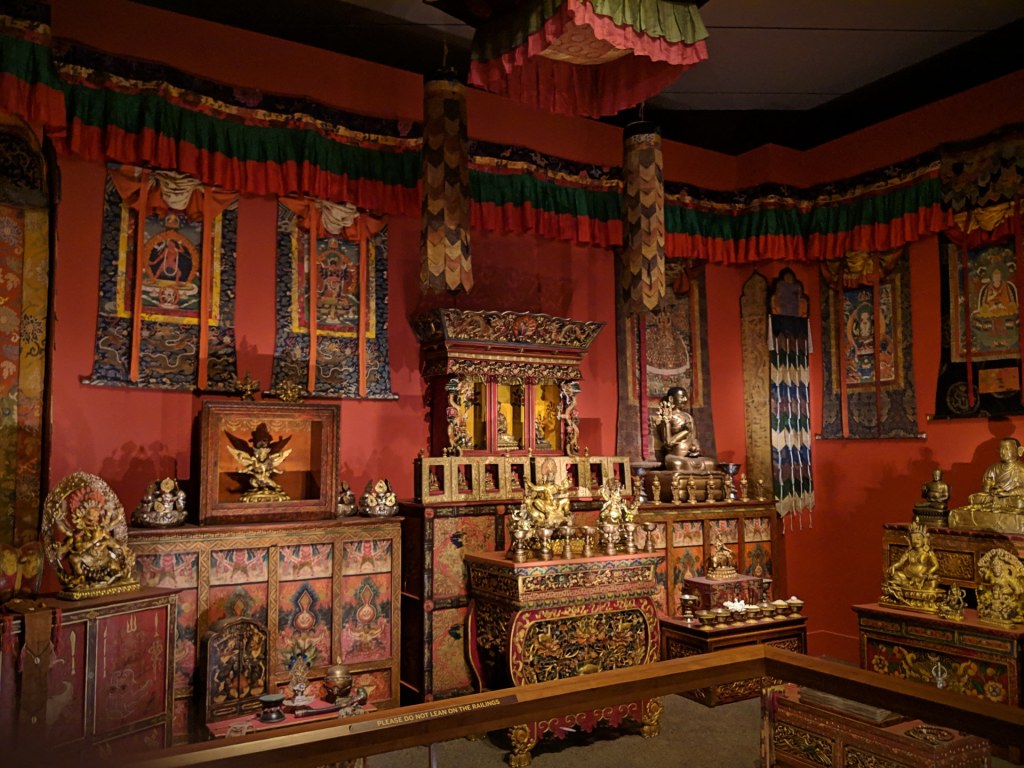
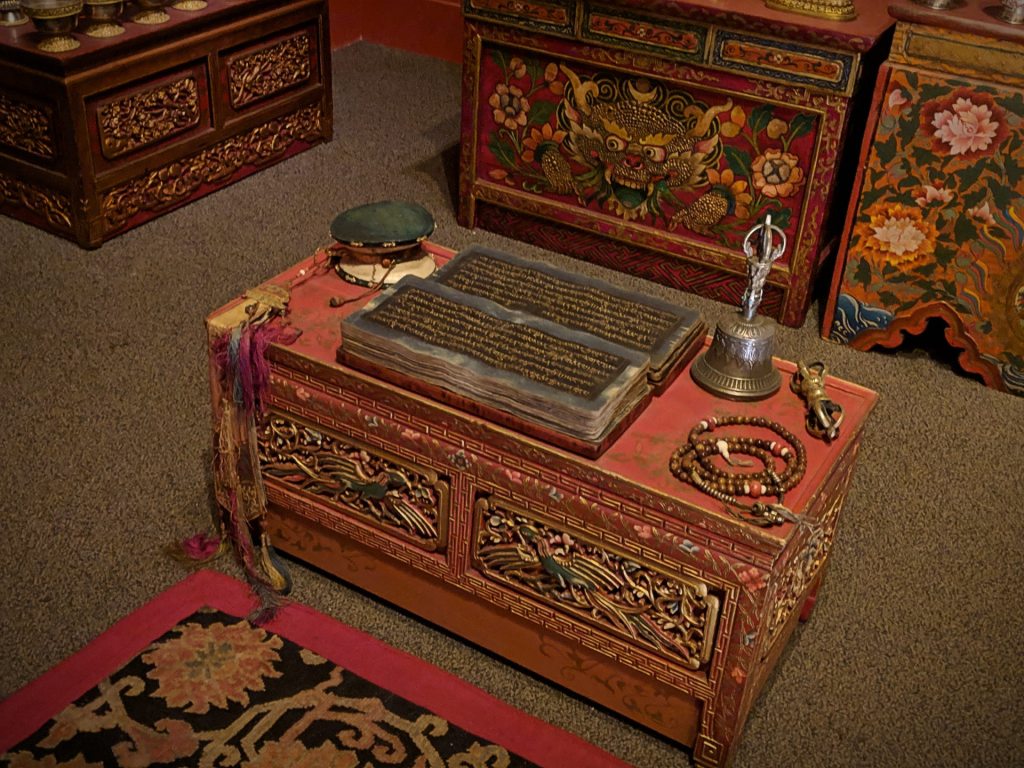
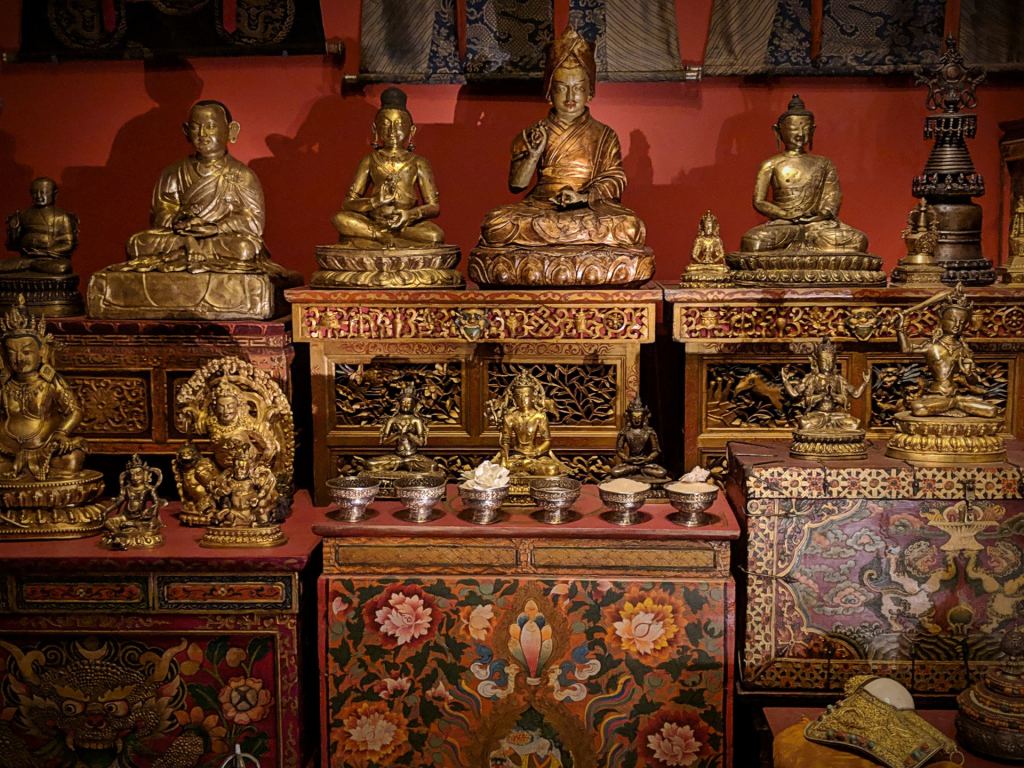
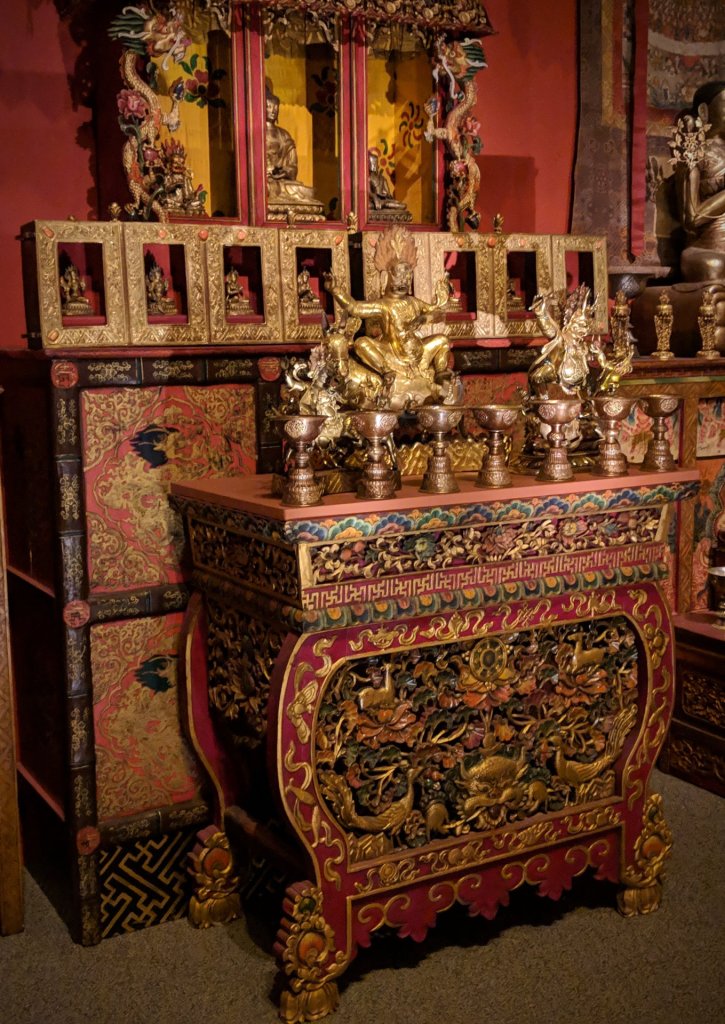
Tibetan Buddhist Shrine Room More than two hundred objects, assembled by the New York collector Alice S. Kandell over many years, reflect Tibetan Buddhist concepts and customs rather than museum conventions.
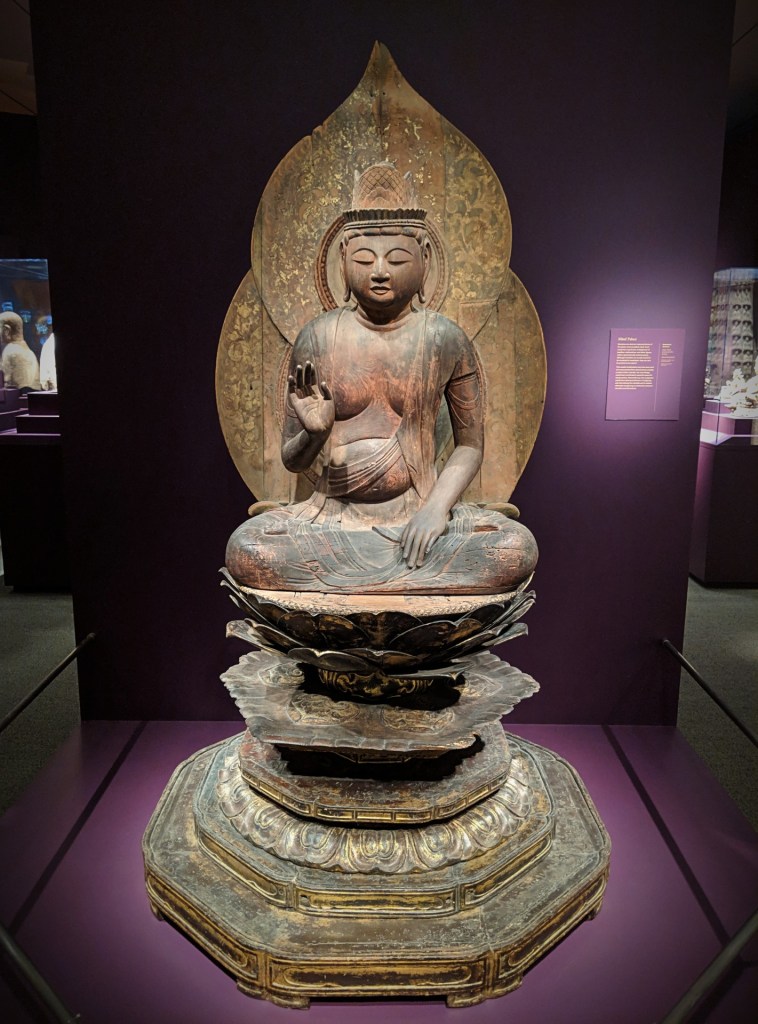
Bodhisattva Japan, Heian period, late 12th century – Wood with gold leaf Mandalas are abstract representations of the places where buddhas dwell. Although mandalas are usually meant to be visualized in meditation, they can also be painted and sculpted.
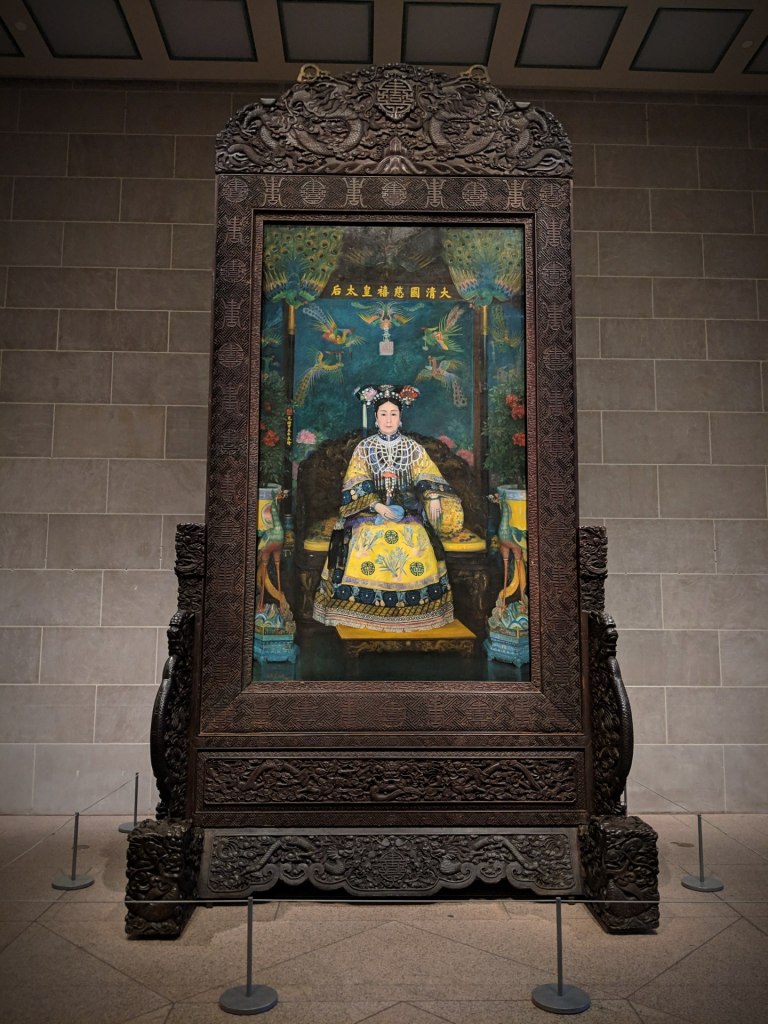
Empress Dowager Cixi Katharine A. Carl (1865-1938) Guangxu period (1875-1908), 1903 Oil on canvas Frame: camphor wood Arguably the most powerful empress in Chinese history, Empress Dowager Cixi (pronounced tsz xyi) dominated the court and policies of China’s last imperial dynasty for nearly fifty years.
The Freer Gallery of Art and Arthur M. Sackler Gallery, National Museum of Asian Art
Free listening and free download (mp3) chill and down tempo music (album compilation ep single) for free (usually name your price). Full merged styles: trip-hop electro chill-hop instrumental hip-hop ambient lo-fi boombap beatmaking turntablism indie psy dub step d'n'b reggae wave sainte-pop rock alternative cinematic organic classical world jazz soul groove funk balkan .... Discover lots of underground and emerging artists from around the world.

























 The Humble Fabulist